Solution Manual for The Mechanical Universe: Introduction to Mechanics and Heat
Authors: Richard P. Olenick, Tom M. Apostol, David L. Goodstein
Solution Manual for The Mechanical Universe: Introduction to Mechanics and Heat is sold on this page. Have a question? We’re here to help
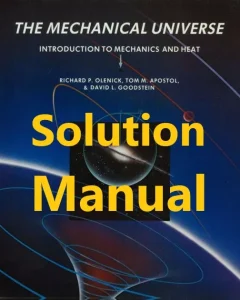
This product is official Solution Manual of the book which covers chapters 1 to 29. The Solution Manual looks is scanned PDF file which has 142 pages totally. File size: 2.75 MB. Please take a look at the preview to confirm content quality before purchase.
Download Sample for Solution Manual for The Mechanical Universe: Introduction to Mechanics and Heat
About the main textbook:
“The Mechanical Universe: Introduction to Mechanics and Heat” is a comprehensive textbook authored by Richard P. Olenick, Tom M. Apostol, and David L. Goodstein. The book is designed to provide students with a solid foundation in classical mechanics and thermodynamics, integrating conceptual understanding with mathematical rigor.
One of the book’s primary objectives is to introduce fundamental principles of mechanics through a clear and structured approach. It covers essential topics such as motion, forces, energy, momentum, and the laws of thermodynamics. The authors emphasize not only the ‘how’ but also the ‘why’ behind physical phenomena, encouraging students to develop a deeper comprehension of the subject matter.
The text begins with an exploration of kinematics, where the authors discuss the motion of objects in one and two dimensions. They introduce key concepts such as displacement, velocity, and acceleration, providing a solid groundwork for understanding dynamics. The subsequent chapters delve into Newton’s laws of motion, illustrating how these principles govern the behavior of objects under various forces.
In addition to classical mechanics, “The Mechanical Universe” also addresses heat and thermodynamics. The authors explain concepts such as temperature, heat transfer, and the laws of thermodynamics in a manner that connects them to mechanical principles. This interdisciplinary approach helps students see the interconnectedness of different areas of physics.
Throughout the book, the authors utilize a variety of pedagogical techniques, including problem-solving strategies and real-world applications. To facilitate learning, they provide numerous examples and exercises that challenge students to apply their understanding in practical scenarios. The inclusion of a “Solution Manual for The Mechanical Universe” is particularly beneficial, as it offers detailed solutions to problems presented in the text, allowing students to verify their work and deepen their understanding.
Moreover, the book is structured to promote active learning. Each chapter includes questions that encourage critical thinking and discussions that can be used in classroom settings. This interactive approach fosters a collaborative learning environment where students can engage with the material and with each other.
The text also addresses modern developments in physics, linking classical concepts to contemporary scientific thought. By incorporating historical context and advancements in technology, the authors help students appreciate the evolution of mechanical theories and their relevance today.
In summary, “The Mechanical Universe: Introduction to Mechanics and Heat” serves as an essential resource for students seeking to grasp the foundational concepts of physics. With its clear explanations, rigorous problem sets, and supportive materials like the “Solution Manual for The Mechanical Universe,” it equips learners with the tools necessary for success in physics courses. The book not only prepares students for future studies in science and engineering but also cultivates a lifelong appreciation for the principles that govern our universe.
In conclusion, whether you are a student or an educator, this book stands out as a valuable guide to understanding mechanics and heat, making it an indispensable part of any physics curriculum. For those looking for additional support while studying, the “Solution Manual for The Mechanical Universe” can be an excellent companion to enhance the learning experience.
You can find more information about the textbook in this link.
Please note: The main textbook is not included. This file contains only the complete solutions as described above. You can contact us if you need assistance.