
Solution Manual for Fundamentals of Combustion Processes
Authors: Sara McAllister, Jyh-Yuan Chen, A. Carlos Fernandez-Pello
You can access Solution Manual for Fundamentals of Combustion Processes by McAllister et al. on this page. If you have any questions, please contact us.
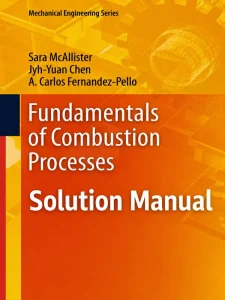
This product is the official Solution Manual which covers chapters 1 to 10 of the book. There is no solutions for chapter 4. The solution Manual is a PDF file with 59 pages. This product has a total size of 468 KB. We recommend checking the sample before placing your order.
Download Sample for Solution Manual for Fundamentals of Combustion Processes by McAllister et al.
List of Covered Chapters in the Solution Manual for Fundamentals of Combustion Processes by McAllister et al.
- Chapter 1 – Fuels
- Chapter 2 – Thermodynamics of Combustion
- Chapter 3 – Chemical Kinetics
- Chapter 4 – Review of Transport Equations and Properties
- Chapter 5 – Ignition Phenomena
- Chapter 6 – Premixed Flames
- Chapter 7 – Non-premixed Flames Diffusion Flames
- Chapter 8 – Droplet Evaporation and Combustion
- Chapter 9 – Emissions
- Chapter 10 – Premixed Piston IC Engines
About the main textbook:
Fundamentals of Combustion Processes by Sara McAllister, Jyh-Yuan Chen, and A. Carlos Fernandez-Pello is a textbook designed to introduce students to the essential science and engineering principles behind combustion. It is especially useful for upper-level undergraduate and graduate students in mechanical engineering, aerospace engineering, chemical engineering, energy systems, and fire protection engineering. The book explains combustion as a multidisciplinary subject that combines thermodynamics, fluid mechanics, heat transfer, mass transfer, and chemical kinetics.
The book begins by discussing fuels and their properties. Readers learn about gaseous, liquid, and solid fuels, as well as the factors that affect fuel selection and combustion performance. This foundation is important because combustion behavior depends heavily on the type of fuel, its chemical composition, and the way it mixes with oxidizers. For students working through exercises, the Solution Manual for Fundamentals of Combustion Processes by McAllister et al. can be a helpful companion for checking calculation methods and understanding problem-solving steps.
A major part of the textbook focuses on combustion thermodynamics. The authors explain concepts such as stoichiometry, equivalence ratio, heat of combustion, adiabatic flame temperature, and chemical equilibrium. These topics help students understand how much energy can be released from a fuel and how combustion products are formed. The book also introduces chemical kinetics, showing how reaction rates, activation energy, and reaction mechanisms influence ignition and flame behavior.
Another important section covers transport processes. Combustion does not occur through chemistry alone; it also depends on the movement of heat, mass, and momentum. The authors review diffusion, convection, viscosity, thermal conductivity, and species transport, all of which are necessary for understanding real flame systems. In this part, the Solution Manual for Fundamentals of Combustion Processes by McAllister et al. may support learners who need extra guidance with equations, derivations, and applied examples.
The book also explains ignition, premixed flames, and diffusion flames. Ignition is treated as a process involving heat generation, heat loss, and chemical reaction rates. Premixed flames are discussed in terms of flame speed, flame thickness, flammability limits, and flame stabilization. Diffusion flames are explained through fuel-air mixing, flame structure, and practical examples such as burners and fires. These chapters are especially valuable because they connect theoretical combustion principles to visible flame behavior.
In addition, the textbook addresses practical combustion applications. It helps readers see how the same scientific principles apply to engines, gas turbines, industrial burners, propulsion systems, and fire safety problems. The authors also discuss emissions and environmental issues, including carbon monoxide, nitrogen oxides, soot, and incomplete combustion. This makes the book relevant not only for traditional energy systems but also for modern engineering challenges involving efficiency, pollution control, and sustainable design. Students using the Solution Manual for Fundamentals of Combustion Processes by McAllister et al. can better follow how textbook theory is applied to these engineering problems.
One of the strengths of Fundamentals of Combustion Processes is its educational structure. It presents complex material in a logical order, moving from basic fuel properties and thermodynamics to more advanced flame and transport phenomena. The writing is technical but accessible, and the examples help students connect equations with physical meaning. The book is not simply a collection of formulas; it encourages readers to understand why combustion behaves the way it does.
Overall, this book is a valuable resource for anyone studying combustion science for the first time or reviewing the fundamentals for research and engineering work. It gives readers the tools to analyze flames, evaluate combustion systems, understand emissions, and approach real-world energy and safety problems with a stronger technical foundation. For learners who want additional support with practice problems, the Solution Manual for Fundamentals of Combustion Processes by McAllister et al. can help reinforce the concepts covered throughout the textbook.
You can find more information about the textbook in this link.
Important Note: The main textbook is not included in this product. This file contains only the Solution Manual as described above. If you have questions about this Solution Manual, you are welcome to contact us.


