

Instructor Guide for Lecture Tutorials for Introductory Astronomy – 4th Edition
Authors: Ed Prather, Gina Brissenden, Colin Wallace, Jeffery Adams
The Instructor Guide for Lecture Tutorials for Introductory Astronomy by Prather and et al. is available on this page. If you have any questions, our support team is happy to help.
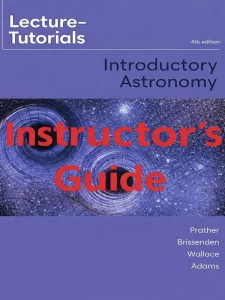
This product is official resources for 4th Edition which includes Instructor Guide and Figure Slides. Instructor Guide includes Tutorial Guide and Additional Questions with key answers for each of sub-parts. There is one pdf files for each of parts 1 to 5 and has 218 pages totally. The complete product size is 107 MB. We recommend checking the sample before buying.
List of Covered Chapters in the Instructor Guide for Lecture Tutorials for Introductory Astronomy by Prather
- Part 1 – The Night Sky
- Position
- Motion
- Seasonal Stars
- Solar vs. Sidereal Day
- Ecliptic
- Star Charts
- Part 2 – Fundamentals of Astronomy
- Kepler’s Second Law
- Kepler’s Third Law
- Newton’s Law and Gravity
- Apparent and Absolute Magnitudes of Stars.
- The Parsec
- Parallax and Distance
- Spectroscopic Parallax
- Part 3 – Nature of Light in Astronomy
- Electromagnetic (EM) Spectrum of Light
- Telescopes and Earth’s Atmosphere
- Observing the Universe with Multiple Telescopes.
- Luminosity, Temperature, and Size
- Blackbody Radiation
- Types of Spectra
- Light and Atoms
- Observing the Invisible-Molecular Excitations and Synchrotron Radiation
- Analyzing Spectra
- Doppler Shift
- Part 4 – Our Solar System
- The Cause of Moon Phases
- Predicting Moon Phases
- Path of the Sun
- Seasons
- Observing Retrograde Motion
- Earth’s Changing Surface
- Greenhouse Effect
- Formation of Planets in the Solar System
- Sizing Up the Planets
- Comparing the Surfaces of Planets
- Sun Size
- part 5 – Stars, Galaxies, and Beyond
- H-R Diagram
- Star Formation and Lifetimes
- Binary Stars
- Detecting Extrasolar Planets with the Doppler Method
- Detecting Exoplanets with the Transit Method
- Stellar Evolution
- Milky Way Scales
- Galaxy Classification
- Dark Matter
- Looking at Distant Objects
- Expansion of the Universe
- Hubble-Lemaître Law
- Making Sense of the Universe and Expansion
- Expansion, Lookback Times, and Distances
- Detecting Exoplanets with Gravitational Microlensing
- The Big Bang
About the main textbook:
Lecture Tutorials for Introductory Astronomy, 4th Edition is a widely used instructional resource designed to support active learning in introductory astronomy courses. Rather than functioning as a traditional textbook, this book focuses on helping students develop conceptual understanding through guided questioning, peer discussion, and instructor‑facilitated reasoning. It is especially well suited for large lecture environments where student engagement can otherwise be difficult to maintain.
The tutorials are structured to target well‑documented student misconceptions in astronomy, such as misunderstandings about lunar phases, seasons, gravity, light, and the scale of the universe. Each tutorial typically begins with carefully crafted questions that ask students to predict outcomes or explain phenomena based on their current understanding. As students work through the activities, they are guided toward scientifically accurate reasoning through comparison, discussion, and reflection.
A major strength of the book is its strong grounding in physics education research and astronomy education research. The authors—who are experienced educators and researchers—designed the tutorials based on real classroom data and iterative testing. This ensures that the activities address the most common conceptual difficulties students face, making the learning process more efficient and meaningful.
The 4th edition reflects updates aligned with modern introductory astronomy curricula. Topics are clearly organized to complement standard astronomy textbooks and lectures, covering areas such as celestial motion, the Earth–Moon–Sun system, gravity and orbits, light and spectra, stars, galaxies, and cosmology. Instructors can easily integrate the tutorials into their courses as short in‑class activities, discussion prompts, or recitation exercises.
For instructors, the accompanying instructional materials are especially valuable. The Instructor Guide for Lecture Tutorials for Introductory Astronomy by Prather provides detailed explanations of correct answers, common student errors, and effective facilitation strategies. These insights help instructors anticipate student thinking and guide discussions more productively without simply giving away answers.
Another advantage of the resource is its flexibility. The tutorials can be used in both algebra‑based and conceptual astronomy courses and adapted for different teaching styles. Whether used weekly or selectively, they encourage students to actively engage with astronomy concepts rather than passively memorize facts.
The Instructor Guide for Lecture Tutorials for Introductory Astronomy by Prather is particularly useful for new instructors or teaching assistants, as it offers pedagogical context and practical classroom advice. It helps educators understand not only what the correct answers are, but why students struggle and how to address those struggles effectively.
Overall, Lecture Tutorials for Introductory Astronomy, 4th Edition is a powerful tool for improving student understanding and engagement. When paired with the Instructor Guide for Lecture Tutorials for Introductory Astronomy by Prather, it becomes an even more effective resource for delivering research‑based, student‑centered astronomy instruction.
You can find more information about the textbook in this link.
This product includes the Instructor Guide + Figure Slide as described prior. The main textbook is not part of this product. Please contact us if you need further assistance.


