Solution Manual for Power Electronics: Converters, Applications, and Design – 3rd Edition
Authors: Ned Mohan, Tore M. Undeland, William P. Robbins
Solution Manual for Power Electronics by Mohan and Undeland is sold on this page. You can contact us if you have any questions.
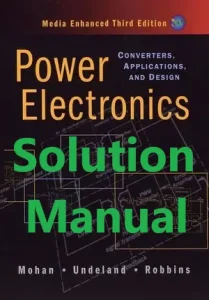
This product is official resources for 3rd Edition which includes Solutions Manual, Supplemental Problems, Solutions for Supplemental Problems, pspice_software, PSpice-based Examples and Lecturer’s PowerPoint slides. Solution Manual for Power Electronics covers chapters 1 to 29, some part is handwritten. There is one PDF file as the solution for each of problems. Supplemental Problems with Solutions are available for chapters 1 to 30. Also, Lecturer’s PowerPoint slides are available in PPT and PDF format for all chapters. Total size of product is 387 MB. Please, check the sample solutions before your payment.
Download Sample for Solution Manual for Power Electronics
About the main textbook:
“Power Electronics: Converters, Applications, and Design,” 3rd Edition, authored by Ned Mohan, Tore M. Undeland, and William P. Robbins, is a comprehensive textbook that provides an in-depth exploration of power electronics, a field that has become increasingly vital in modern electrical engineering. This book is particularly significant for students, educators, and professionals involved in electrical engineering and related disciplines.
▎Overview of the Book
The third edition of this influential textbook builds upon the foundations laid in previous editions while incorporating new developments and technologies in the field of power electronics. The authors have meticulously structured the content to facilitate a clear understanding of power electronic converters, their applications, and the design principles that govern them.
▎Key Themes and Structure
1. Fundamentals of Power Electronics:
The book begins with an introduction to the basic concepts and principles of power electronics. It covers essential topics such as semiconductor devices, including diodes, transistors, and thyristors, which are crucial for understanding how power electronic converters function.
2. Power Converter Topologies:
A significant portion of the book is dedicated to different types of power converter topologies. The authors categorize converters into DC-DC converters, DC-AC converters (inverters), AC-DC converters (rectifiers), and AC-AC converters.
3. Control Techniques:
Control of power converters is a critical aspect covered extensively in the book. The authors discuss various control techniques, including voltage and current control strategies. They delve into feedback and feedforward control methods, emphasizing the importance of stability and response time in converter design.
4. Applications of Power Electronics:
The text explores a wide range of applications for power electronics, demonstrating its relevance across various industries. Applications discussed include renewable energy systems (such as solar and wind power), electric vehicles, industrial motor drives, and power supplies for telecommunications and consumer electronics.
5. Design Considerations:
Design is a critical theme throughout the book. The authors provide guidelines on how to approach the design of power electronic converters, emphasizing the need for a systematic methodology. This includes selecting appropriate components, thermal management, electromagnetic interference (EMI) considerations, and reliability assessments.
6. Emerging Trends and Technologies:
In this third edition, the authors have included discussions on emerging trends in power electronics, such as wide-bandgap semiconductor devices (like SiC and GaN), which offer significant advantages over traditional silicon-based devices in terms of efficiency and thermal performance.
▎Conclusion
“Power Electronics: Converters, Applications, and Design” stands out as an authoritative resource in the field of power electronics. Its comprehensive coverage of fundamental principles, converter topologies, control strategies, applications, and design considerations makes it an invaluable tool for students and professionals alike.
Overall, this textbook is not just a reference work; it is a guide that empowers readers to understand and innovate within the rapidly evolving domain of power electronics. Whether one is a student embarking on their studies or a seasoned engineer looking to deepen their knowledge, this book serves as an essential resource for mastering the complexities of power electronic systems.
You can find more information about the textbook in this link.
This product does not contain the main textbook. It includes Solution Manual for Power Electronics + other files as described upper. You can contact us if you have any questions.