
Solution Manual for Signals, Systems, & Transforms – 5th Edition
Author: Charles Phillips, John Parr, Eve Riskin
You can purchase the Solution Manual for Signals, Systems, & Transforms by Phillips and Parr directly on this page. Have any questions? Feel free to contact us .
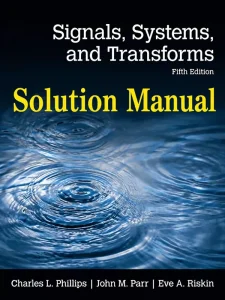
This product includes the official Solution Manual for the 5th Edition covers Chapters 2 to 13. There is one PDF file for each of chapters which has 369 pages totally. Most part of this Solution Manual is handwritten, So we recommend reviewing the sample provided below prior to your purchase. File size: 23.4 MB.
Download Sample for Solution Manual for Signals, Systems, & Transforms by Phillips and Parr
List of Covered Chapters in the Solution Manual for Signals, Systems, & Transforms by Phillips and Parr
- Chapter 2 – Continuous-Time Signals and Systems
- Chapter 3 – Continuous-Time Linear Time-Invariant Systems
- Chapter 4 – Fourier Series
- Chapter 5 – The Fourier Transform
- Chapter 6 – Applications of the Fourier Transform
- Chapter 7 – The Laplace Transform 336
- Chapter 8 – State Variables for Continuous-Time Systems
- Chapter 9 – Discrete-Time Signals and Systems
- Chapter 10 – Discrete-Time Linear Time-Invariant Systems
- Chapter 11 – The z-Transform
- Chapter 12 – Fourier Transforms of Discrete-Time Signals
- Chapter 13 – State Variables for Discrete-Time Systems
About the main textbook:
“Signals, Systems, & Transforms,” authored by Charles L. Phillips, John M. Parr, and Eve A. Riskin, is a cornerstone textbook in the undergraduate electrical and computer engineering curriculum. Now in its fifth edition, the text has established itself as an essential guide for students grappling with the abstract mathematical frameworks that underpin modern communication, control, and signal processing systems.
At its heart, the book is designed to bridge the gap between abstract mathematical theory and the physical, real-world application of engineering principles. It begins by grounding students in the fundamentals of signal analysis, clearly distinguishing between continuous-time and discrete-time signals. This foundational work is crucial because the subsequent chapters build heavily upon these definitions. For those working through the complex problem sets found in the exercises, the Solution Manual for Signals, Systems, & Transforms by Phillips and Parr provides a vital resource to help verify understanding of these initial concepts.
The text moves systematically into the analysis of linear time-invariant (LTI) systems. This is arguably the most critical section of the book, as it introduces concepts like convolution, impulse response, and system stability—ideas that are central to how engineers model everything from audio filters to complex aerospace control systems. The authors place a strong emphasis on linearity and time invariance, helping students recognize when these simplifications can be applied to complex physical systems. Often, students find that working through the worked examples in the Solution Manual for Signals, Systems, & Transforms by Phillips and Parr helps clarify these LTI concepts, turning abstract equations into intuitive tools.
Perhaps the most famous—and challenging—portion of the curriculum covers “Transforms.” The book excels here by providing an integrated treatment of the Fourier Series, Fourier Transform, Laplace Transform, and the Z-Transform. By presenting these tools together, Phillips, Parr, and Riskin demonstrate how different transforms are simply different ways of looking at the same underlying information in either the frequency or time domain. This section is dense with mathematical derivation, requiring a high degree of focus. Many students rely on the step-by-step guidance provided in the Solution Manual for Signals, Systems, & Transforms by Phillips and Parr to navigate these difficult mathematical derivations, ensuring they don’t get lost in the algebra.
Beyond the core mathematics, the 5th edition is well-regarded for its emphasis on engineering application. It includes numerous examples and computer-based problems that encourage the use of software like MATLAB, which is standard in the industry. This practical component helps solidify the theory; seeing a signal transformed in code is often the “lightbulb moment” for many students.
Ultimately, this textbook is structured to prepare students for advanced study in communications, digital signal processing, and control theory. It is a rigorous, structured, and comprehensive volume. While it provides an excellent roadmap for learning, the depth of the material means that students frequently need additional support to ensure they are applying the methods correctly. This is where the Solution Manual for Signals, Systems, & Transforms by Phillips and Parr proves most valuable, serving as a reliable companion for cross-checking complex problem-solving strategies and ensuring accuracy in homework and study preparation. By mastering the concepts laid out in this text, students gain the analytical maturity required for professional engineering practice.
You can find more information about the textbook in this link.
Please note: This product is the Solution Manual only and does not include the textbook. Review the description above for details, and feel free to contact us with any questions.


