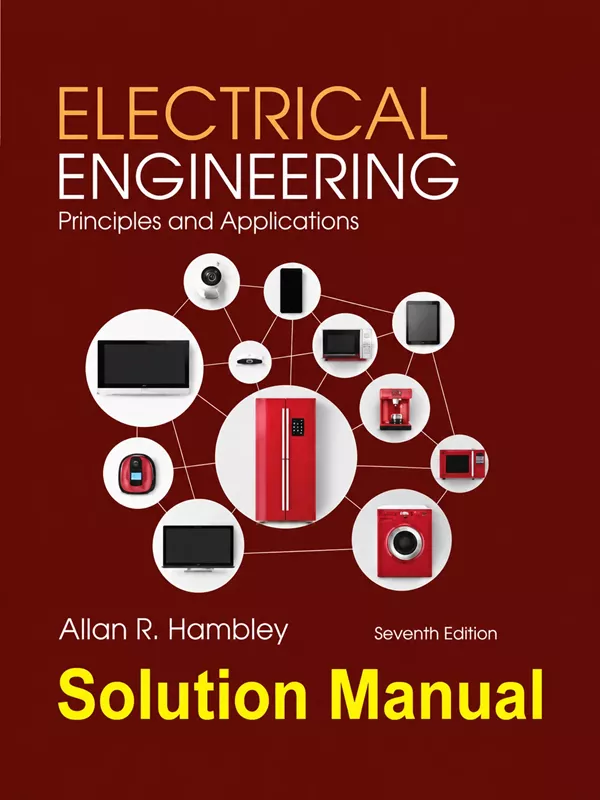
Solution Manual for Electrical Engineering, Principles & Applications – 7th Edition
Author: Allan Hambley
Purchase the complete Solution Manual for Electrical Engineering by Allan Hambley on this page. Have any questions? We’re always here to help!
This product is the official resources for 7th Edition which includes Solution Manual and Images slides. Solution Manual Electrical Engineering by Allan Hambley covers all chapters 1 to 16 + Appendix A in PDF format and has 704 pages totally. In addition, Images slides are available in the package. File size: 161 MB. We highly recommend reviewing the sample provided below to ensure it’s exactly what you need before purchasing.
Download Sample for Solution Manual Electrical Engineering by Allan Hambley
List of Covered Chapters in the Solution Manual Electrical Engineering by Allan Hambley (7th Edition)
- Chapter 1 – Introduction
- Chapter 2 – Resistive Circuits
- Chapter 3 – Inductance and Capacitance
- Chapter 4 – Transients
- Chapter 5 – Steady-State Sinusoidal Analysis
- Chapter 6 – Frequency Response, Bode Plots, and Resonance
- Chapter 7 – Logic Circuits
- Chapter 8 – Computers, Microcontrollers, and Computer-Based Instrumentation Systems
- Chapter 9 – Diodes
- Chapter 10 – Amplifiers: Specifications and External Characteristics
- Chapter 11 – Field-Effect Transistors
- Chapter 12 – Bipolar Junction Transistors
- Chapter 13 – Operational Amplifiers
- Chapter 14 – Magnetic Circuits and Transformers
- Chapter 15 – DC Machines
- Chapter 16 – AC Machines
About the main textbook:
Electrical Engineering: Principles & Applications (7th Edition) by Allan R. Hambley stands out as one of the most widely adopted and respected introductory textbooks in higher education. Designed primarily for non-electrical engineering majors—including mechanical, civil, biomedical, aerospace, and chemical engineering students—as well as beginning electrical engineering undergraduates, the book bridges foundational scientific concepts and practical engineering applications.
Allan R. Hambley’s pedagogical philosophy centers on clarity, accessibility, and relevance. Rather than overwhelming students with overly abstract mathematics from day one, Hambley focuses on physical intuition, problem-solving methodologies, and fundamental circuit principles that engineers encounter across various technical disciplines.
The 7th Edition presents a modern, balanced curriculum structured into logical thematic units:
- Foundations of Circuit Theory: The text begins with fundamental concepts such as voltage, current, power, and energy. It thoroughly covers Ohm’s Law, Kirchhoff’s Current Law (KCL), Kirchhoff’s Voltage Law (KVL), and essential network theorems such as Thévenin and Norton equivalents. Students learn systematic analysis techniques using node-voltage and mesh-current methods.
- AC Circuits and Frequency Domain: Hambley provides an intuitive introduction to sinusoidal steady-state analysis, phasors, impedance, power factor correction, and three-phase circuits. Understanding reactive power and real power is critical for engineers working with industrial machinery and electrical grids.
- Transient Analysis and First/Second-Order Circuits: The textbook details differential equations governing RC, RL, and RLC circuits. Understanding transient behavior enables students to grasp how control systems, switches, and energy-storage elements behave during dynamic transitions. When working through complex end-of-chapter differential problems, students often rely on the Solution Manual Electrical Engineering by Allan Hambley to verify their mathematical steps and steady-state boundaries.
- Electronics and Semiconductor Devices: Hambley offers an accessible treatment of diodes, operational amplifiers (op-amps), bipolar junction transistors (BJTs), and field-effect transistors (FETs). The coverage of op-amp circuits—including inverting, non-inverting, summing, and integrator configurations—is particularly renowned for its clarity.
- Digital Systems and Logic: The textbook introduces binary numbers, Boolean algebra, logic gates, flip-flops, and basic microcontrollers. This section ensures that engineers understand digital interfaces, embedded systems, and automated data acquisition.
- Electromechanics and Power Systems: Crucial for mechanical and civil engineers, these chapters explore magnetic circuits, transformers, DC motors, and AC induction machines. Hambley focuses on electromechanical energy conversion, torque production, and power efficiency.
The 7th Edition brought several key enhancements over previous editions:
- Real-World Engineering Context: Every chapter includes “Focus on Methodology” and practical engineering problem scenarios that demonstrate how theoretical formulas apply to modern instruments, industrial sensors, and consumer electronics.
- Refined Explanations and Pedagogy: Hambley carefully reorganized sections to ensure smoother transitions between DC resistive circuits and time-varying signals.
- Expanded Problem Sets: A diverse range of end-of-chapter exercises—ranging from straightforward review questions to challenging design problems—challenges students at various skill levels. Because these assignments require rigorous algebraic and calculus-based calculations, having access to the Solution Manual Electrical Engineering by Allan Hambley helps learners self-assess their progress, troubleshoot calculation errors, and prepare effectively for midterms and final exams.
- Software Integration: The text highlights simulation tools such as MATLAB and SPICE, teaching students how to simulate circuit behavior digitally before testing hardware in laboratory settings.
The primary strength of Hambley’s textbook is its interdisciplinary appeal. Engineering curricula worldwide recognize that almost all modern mechanical and industrial systems integrate electronic sensors, digital processors, and electric actuators. A mechanical engineer designing an automotive suspension or robotics arm must understand circuit response times, motor torque characteristics, and signal conditioning.
Hambley breaks down complex mathematical abstractions into manageable, step-by-step concepts. To complement lecture materials and laboratory experiments, instructors and teaching assistants regularly consult the official Solution Manual Electrical Engineering by Allan Hambley when crafting homework assignments, quizzes, and grading rubrics.
Electrical Engineering: Principles & Applications (7th Edition) by Allan R. Hambley remains an essential benchmark in modern engineering education. By combining theoretical rigor with real-world practicality, intuitive illustrations, and structured problem-solving frameworks, Hambley equips future engineers with the electrical engineering literacy required in an increasingly automated and electrified world. For students aiming to master circuit analysis, signal processing, and electromechanical fundamentals, studying Hambley’s clear chapters alongside the Solution Manual Electrical Engineering by Allan Hambley provides an effective, comprehensive pathway toward academic and professional success.
You can find more information about the textbook in this link.
Important: This product is the Solution Manual + Image Slides and does not include the main textbook. Please refer to the description above for full details. If you have any questions, we are happy to help.


