Instructors Solution Manual for Electrochemical Methods: Fundamentals and Applications 3rd Edition
Authors: Allen J. Bard, Larry R. Faulkner, Henry S. White, Cynthia G. Zoski
This page offers the Instructor’s Solution Manual for Electrochemical Methods by Allen Bard. Contact us for any questions or clarifications.
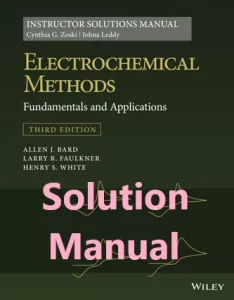
This product is Instructor Solution Manual for 3rd edition (not student solution manual). Solution Manual for Electrochemical Methods by Allen Bard is a PDF file with 416 pages which covers chapters 1 to 20 + Appendixes A and B. Please consider that this product is instructor’s Solution Manual which differ from Student’s Solution Manual. Product size is 12.9 MB. Please review the sample pages before completing your purchase.
Download Sample for Solution Manual for Electrochemical Methods by Allen Bard
Table of Contents for Solution Manual
1. Overview of electrode processes
2. Potentials and thermodynamics of cells
3. Basic kinetics of electrode reactions
4. Mass transfer by migration and diffusion
5. Steady-state voltammetry at ultramicroelectrodes
6. Transient methods based on potential steps
7. Linear sweep and cyclic voltammetry
8. Polarography, pulse voltammetry, and square-wave Voltammetry
9. Controlled-current techniques
10. Methods involving forced convection – hydrodynamic methods
11. Electrochemical impedance spectroscopy and ac voltammetry
12. Bulk electrolysis
13. Electrode reactions with coupled homogeneous chemical reactions
14. Double-layer structure and adsorption
15. Inner-sphere electrode reactions and electrocatalysis
16. Electrochemical instrumentation
17. Electroactive layers and modified electrodes
18. Scanning electrochemical microscopy
19. Single-particle electrochemistry
20. Photoelectrochemistry and electrogenerated chemiluminescence
Appendix A. Mathematical methods
Appendix B. Basic concepts of simulations
About the main textbook:
“Electrochemical Methods: Fundamentals and Applications,” 3rd Edition, by Allen J. Bard and Larry R. Faulkner, is a comprehensive resource that delves into the principles and applications of electrochemistry. This edition builds upon the solid foundation laid by its predecessors, incorporating new research findings, updated techniques, and a broader range of applications relevant to modern science and technology.
The book is structured to cater to both beginners and advanced readers, making it an essential text for students, researchers, and professionals in the field of chemistry and related disciplines. It begins with fundamental concepts such as the thermodynamics of electrochemical processes, the nature of electrodes, and the principles governing electrochemical cells. The authors meticulously explain key topics like Nernst equation, electrode kinetics, and mass transport phenomena, which are crucial for understanding electrochemical reactions.
One of the standout features of this edition is its emphasis on practical applications. Bard and Faulkner explore how electrochemical methods can be applied in various fields, including analytical chemistry, materials science, and energy conversion technologies. The book discusses techniques such as cyclic voltammetry, potentiometry, and electrochemical impedance spectroscopy, providing readers with insights into how these methods can be utilized in real-world scenarios.
Additionally, the book includes numerous examples and problems that encourage active learning. The authors have included a variety of exercises that challenge readers to apply theoretical concepts to practical situations. This pedagogical approach not only reinforces learning but also prepares students for real-life applications in research and industry.
For those seeking additional resources, the “Solution Manual for Electrochemical Methods by Allen Bard” is an invaluable companion to the textbook. This solution manual provides detailed answers and explanations to the problems presented in the book, facilitating a deeper understanding of the material. By utilizing the solution manual, students can enhance their comprehension of complex topics and verify their problem-solving approaches.
The third edition also pays special attention to contemporary issues such as energy storage and conversion, highlighting the role of electrochemistry in developing sustainable technologies. With increasing global emphasis on renewable energy sources, the book’s discussions on batteries, fuel cells, and electrolysis are particularly relevant. Bard and Faulkner provide insights into current research trends and future directions in electrochemical science, making this edition a timely contribution to the field.
In summary, “Electrochemical Methods: Fundamentals and Applications” 3rd Edition by Allen J. Bard is a thorough exploration of electrochemistry that balances theory with practical application. Its clear explanations, extensive examples, and updated content make it an essential resource for anyone interested in the subject. For those looking to deepen their understanding further, the “Solution Manual for Electrochemical Methods by Allen Bard” offers a supportive tool for mastering the material presented in the textbook. The combination of these resources equips readers with the knowledge necessary to navigate the complexities of electrochemical systems effectively.
In conclusion, whether you’re a student or a professional, this book serves as a fundamental guide to the principles and applications of electrochemistry, complemented by the helpful “Solution Manual for Electrochemical Methods by Allen Bard.”
You can find more information about the textbook in this link.
Please note: The main textbook is not included; this file provides only the Solutions Resource mentioned above. Contact us for more info.