Solution Manual for Communication Systems – 5th Edition
Authors: A. Bruce Carlson, Paul Crilly
You can access the Solution Manual for Communication Systems by Carlson and Crilly on this page. Our support team is available if you need any assistance.
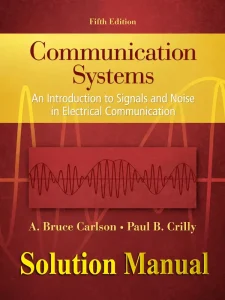
This official resource package for the 5th edition includes the complete Solution Manual, answers to thought questions, MATLAB problems with results, and lecture PowerPoints. The Solution Manual covers chapters 2–16 (383 pages, split by chapter), while the thought questions (42 pages) and MATLAB problems (489 pages) cover chapters 1–15 and 2–15, respectively. Additionally, lecture slides for chapters 1–16 are included. Total file size: 21.8 MB. Please view the sample preview before purchase.
Sample for Solution Manual for Communication Systems by Carlson and Crilly
List of Covered chapters in Solution Manual for Communication Systems by Carlson and Crilly
- Chapter 1 – Introduction
- Chapter 2 – Signals and Spectra
- Chapter 3 – Signal Transmission and Filtering
- Chapter 4 – Linear CW Modulation
- Chapter 5 – Angle CW Modulation
- Chapter 6 – Sampling and Pulse Modulation
- Chapter 7 – Analog Communication Systems
- Chapter 8 – Probability and Random Variables
- Chapter 9 – Random Signals and Noise
- Chapter 10 – Noise in Analog Modulation Systems
- Chapter 11 – Baseband Digital Transmission
- Chapter 12 – Digitization Techniques for Analog Messages and Computer
- Chapter 13 – Data Multiplexers
- Chapter 14 – Bandpass Digital Transmission
- Chapter 15 – Spread-Spectrum Systems
- Chapter 16 – Information and Detection Theory
About the main textbook:
Communication Systems (5th edition) by A. Bruce Carlson and Paul Crilly is a comprehensive textbook that introduces and develops the key ideas behind modern communication engineering. The book is intended for students who want a strong foundation in how information is transmitted reliably and efficiently over physical channels—such as wired networks, wireless systems, and other real-world media.
A major theme of the book is the complete journey from signals to transmission. It explores how signals are represented and processed, how modulation techniques encode information onto carriers, and how receivers recover the original information despite noise and distortion. Throughout the text, concepts are presented in a way that connects mathematical models to engineering meaning, which helps readers understand why certain approaches work and when they are used.
The 5th edition typically emphasizes both breadth and depth. Readers are guided through fundamental building blocks such as:
- Signal representation and system behavior, including the concepts needed to analyze communication channels.
- Modulation and demodulation, explaining how analog and digital information can be mapped onto waveforms suitable for transmission.
- Noise, filtering, and receiver design, showing how to reduce uncertainty and improve signal recovery.
- Probability and performance analysis, including the metrics engineers use to judge how well a system works.
The authors also highlight the importance of understanding communication systems not only as isolated circuits, but as complete systems with interacting components—transmitter, channel, and receiver—each affecting overall performance.
One reason Communication Systems is popular in academic settings is its emphasis on structured problem-solving. The material is often supported by examples that walk through calculations step by step, demonstrating how to apply theory to practical questions. This approach helps students build confidence with the mathematics involved in communications, including transforms, spectral reasoning, and performance evaluations.
As with many rigorous engineering textbooks, students commonly need extra guidance to fully master the problem types found in homework and exams. This is where instructors and learners often turn to Solution Manual for Communication Systems by Carlson and Crilly. A solution manual can help by providing worked solutions that clarify the intermediate reasoning steps—especially in multi-stage problems where the “how” matters as much as the final answer.
When students use Solution Manual for Communication Systems by Carlson and Crilly, it typically supports learning goals such as:
- checking solution steps and identifying where mistakes occur,
- understanding the logic behind a method rather than memorizing outcomes,
- reinforcing key techniques used repeatedly across chapters.
Additionally, seeing full solutions can improve comprehension of topics like modulation performance, error behavior, and receiver decision criteria—areas where intuition alone is not always sufficient.
Classroom and self-study value
Overall, Communication Systems 5th Edition provides a strong conceptual and quantitative base for communication engineering. For those studying independently or preparing for structured assessments, pairing the course material with Solution Manual for Communication Systems by Carlson and Crilly can make review faster and more accurate.
Instructors may also recommend companion resources to help students stay on track and ensure that homework practice translates into real understanding. By combining the main textbook’s explanations with worked problem guidance from Solution Manual for Communication Systems by Carlson and Crilly, students can strengthen both their theoretical knowledge and their ability to solve applied communication problems.
You can find more information about the textbook in this link.
Please note that the main textbook is not included. This product contains the Solution Manual + answers to thought questions + MATLAB problems with results + lecture PowerPoints as mentioned above. If you have any questions, do not hesitate to reach out.