
Solution Manual for Mechanics of Materials 11th Edition in SI Units, 11th Edition, 10th edition in SI Units and 10th Edition
Author: Russell Hibbeler
Find the complete range of the Solution Manual for Mechanics of Materials by Russell Hibbeler (10th and 11th editions, including SI and Standard Version) on this page. If you have any questions, please feel free to contact our support team.
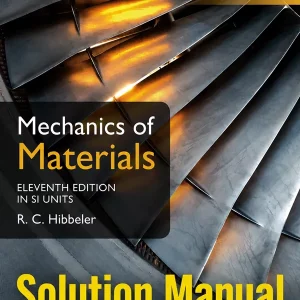
First product is official resources for “Global Edition, 11th Edition in SI Units” which includes Instructor’s Solutions Manual, Lecture PowerPoint Slides and Images Slides. The Solution Manual covers chapters 1 to 14 in PDF format and has 1585 pages. Lecturer PowerPoint slides and Images Slides are available for chapters 1-14. The total file size for this product is 262 MB. We highly recommend reviewing the provided sample before completing your purchase.
Second product is official Solution Manual for the 11th Edition covers all chapters (1–14) and includes every problem type, from standard exercises to review problems. The material is organized into 1,581 pages, with one PDF file for each chapter. This product file is 150 MB. We recommend reviewing the provided sample before finalizing your purchase.
Download Sample for Solution Manual for Mechanics of Materials by Russell Hibbeler 11th Edition
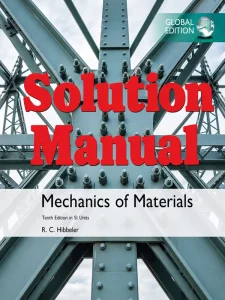
Third product is the Solution Manual for the ‘Mechanics of Materials Tenth Edition in SI Units Global Edition’ provides complete answers for all textbook problems and review problems across chapters 1 through 14. This 138 MB file is available for download. Please ensure you check the sample before making your purchase.
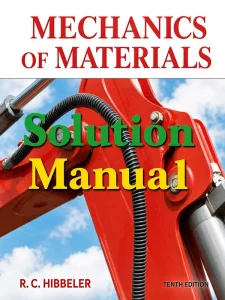
Fourth product is Solution Manual for the ‘Mechanics of Materials 10th Edition’ includes step-by-step answers for all problems and review problems in chapters 1–14. For your convenience, each chapter is available as a separate PDF file. Total file size: 121 MB. Please take a moment to view the sample below before purchasing.
Download Sample for Solution Manual for Mechanics of Materials by Russell Hibbeler 10th Edition
List of Covered Chapters in Solution Manual for Mechanics of Materials by Russell Hibbeler (Global Edition, 11th Edition in SI Units )
- Chapter 1 – Stress
- Chapter 2 – Strain
- Chapter 3 – Mechanical Properties of Materials
- Chapter 4 – Axial Load
- Chapter 5 – Torsion
- Chapter 6 – Bending
- Chapter 7 – Transverse Shear
- Chapter 8 – Combined Loadings
- Chapter 9 – Stress Transformation
- Chapter 10 – Strain Transformation
- Chapter 11 – Design of Beams and Shafts
- Chapter 12 – Deflection of Beams and Shafts
- Chapter 13 – Buckling of Columns
- Chapter 14 – Energy Methods
About the main textbook:
Mechanics of Materials, authored by Russell C. Hibbeler, has long been the gold standard for engineering students and professionals worldwide. Specifically, the Global Edition, 11th Edition in SI Units represents the pinnacle of this pedagogical tradition, combining rigorous academic theory with real-world practical application. This text is essential for anyone pursuing a degree in mechanical, civil, or structural engineering, as it provides the foundational knowledge required to design safe, efficient, and robust structures.
The 11th Edition of this textbook continues the Hibbeler legacy by presenting complex concepts in a clear, accessible, and structured manner. The transition to SI units makes it globally relevant, ensuring that students from various educational systems—including those in Europe, Asia, and the Middle East—can apply the principles directly to their coursework without the confusion of unit conversion errors. Whether you are a student preparing for a rigorous exam or an engineer reviewing structural integrity principles, the depth provided in this volume is unmatched.
At its core, the textbook explores how various materials behave under different types of loading. It covers topics such as stress, strain, axial loading, torsion, bending, transverse shear, and combined loadings. These are not merely abstract concepts; they are the fundamental building blocks for designing bridges, buildings, machinery, and countless other engineered systems. Students frequently find that the most effective way to master these challenging topics is by engaging with a comprehensive Solution Manual for Mechanics of Materials by Russell Hibbeler, which provides the step-by-step guidance necessary to bridge the gap between theory and practice.
This latest edition maintains the hallmark clarity that Hibbeler is known for. It features an extensive array of problems that test conceptual understanding rather than rote memorization. The problems are carefully curated to simulate real-world engineering challenges, requiring students to think critically about material properties, structural geometry, and force interactions.
One of the significant advantages of the 11th Edition is its focus on modern engineering practices. The book includes updated design procedures that reflect current industry standards. However, the sheer volume and complexity of these problems can be daunting for even the most dedicated students. This is where supplementary resources become invaluable. Many top-tier students utilize a Solution Manual for Mechanics of Materials by Russell Hibbeler to verify their methodologies and ensure they are grasping the nuances of statics and dynamics as applied to material science.
To succeed in a course based on this text, students must move beyond reading the chapters. Active problem-solving is the only path to true proficiency. The textbook encourages this through its “Fundamental Problems” section, which allows students to build confidence before tackling the more intricate “Review Problems.” By systematically working through these exercises, you develop an intuition for how loads are transferred through structures and how materials deform under stress.
Navigating the intricacies of Mohr’s Circle, Euler’s buckling formulas, or stress transformation equations can be a formidable challenge. Often, the difference between passing a course and truly mastering it lies in having the right support materials. For those who need extra clarity on how to tackle these advanced problems, a reliable Solution Manual for Mechanics of Materials by Russell Hibbeler acts as a virtual tutor, offering detailed walkthroughs that explain the “why” behind the “how.”
Engineering is ultimately about solving problems for the real world. Hibbeler’s text excels at connecting mathematical models to physical reality. The 11th Edition emphasizes the importance of design safety, factor of safety, and material selection, ensuring that students understand the ethical and professional responsibilities of an engineer.
Whether you are studying for a mid-term exam, preparing for a professional engineering (PE) certification, or simply looking to refresh your knowledge of structural analysis, this book serves as a lifelong reference. Its structured approach to teaching makes it an indispensable tool in any engineer’s library. If you are currently working through the 11th Edition and find yourself hitting a wall with the complex derivation of beam deflections or thermal stress analysis, remember that resources are available to help you persist. Many students have successfully navigated their academic journey by using a Solution Manual for Mechanics of Materials by Russell Hibbeler to cross-check their work and deepen their understanding of structural mechanics.
In conclusion, Mechanics of Materials, Global Edition, 11th Edition in SI Units is more than just a textbook; it is a comprehensive guide to the physical laws that govern our built environment. Through persistent study, a focus on understanding foundational mechanics, and the strategic use of high-quality learning resources, any student can master the material and build a successful engineering career.
You can find more information about the textbook in this link.
Important: Please note that the original textbooks are not included with these products. Each purchase includes the Solution Manual and any associated files described above. Contact us if you require further details.