
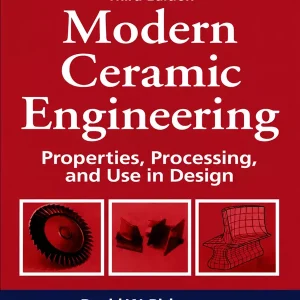
Solution Manual for Modern Ceramic Engineering: Properties, Processing, and Use in Design – 3rd Edition
Author: David W. Richerson
You can Purchase the Solution Manual for Modern Ceramic Engineering by David Richerson on this page. Have questions or need assistance? Feel free to reach out to our support team anytime.
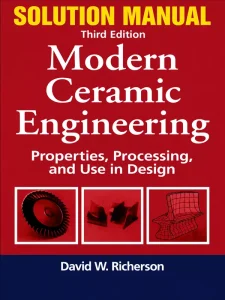
This product is the official Solution Manual of 3rd edition which covers covers these chapters: 4, 5, 6, 7, 8, 9, 10, 11, 12, 13, 14, 15, 16, 18, 20. The Solution Manual is a PDF file with 40 pages. The download size is 564 KB. Please preview the sample provided below before completing your purchase.
Download Sample for Solution Manual for Modern Ceramic Engineering by David Richerson
List of Covered Chapters in the Solution Manual for Modern Ceramic Engineering by David Richerson
- Chapter 1 – What Is a Ceramic? (not included in the Solution Manual)
- Chapter 2 – History of Ceramics (not included in the Solution Manual)
- Chapter 3 – Applications: Engineering with Ceramics (not included in the Solution Manual)
- Chapter 4 – Atomic Bonding and Crystal Structure
- Chapter 5 – Crystal Chemistry and Specific Crystal Structures
- Chapter 6 – Phase Equilibria and Phase Equilibrium Diagrams
- Chapter 7 – Physical and Thermal Behavior
- Chapter 8 – Mechanical Behavior and Measurement
- Chapter 9 – Time, Temperature, and Environmental Effects on Properties
- Chapter 10 – Electrical Behavior
- Chapter 11 – Dielectric, Magnetic, and Optical Behavior
- Chapter 12 – Powder Processing
- Chapter 13 – Shape-Forming Processes
- Chapter 14 – Densification
- Chapter 15 – Final Machining
- Chapter 16 – Quality Assurance
- Chapter 17 – Design Considerations (not included in the Solution Manual)
- Chapter 18 – Design Approaches
- Chapter 19 – Failure Analysis (not included in the Solution Manual)
- Chapter 20 – Toughening of Ceramics
About the main textbook:
Modern Ceramic Engineering: Properties, Processing, and Use in Design, 3rd Edition by David W. Richerson is widely recognized as one of the most comprehensive, accessible, and practical textbooks in the field of materials science and ceramic technology. Since its initial publication, it has served as an essential resource for undergraduate and graduate engineering students, materials scientists, and practicing design engineers who need to understand how ceramic materials behave, how they are fabricated, and how their distinct capabilities can be effectively integrated into modern engineering applications.
Ceramics have evolved far beyond traditional pottery, bricks, and clay products into high-performance structural, electrical, optical, and thermal components used in aerospace, electronics, energy systems, and biomedicine. Richerson’s third edition reflects this continuous progress by organizing the field into three cohesive pillars: atomic and structural fundamentals, manufacturing and synthesis methodologies, and practical design principles.
The first major segment of the book establishes the fundamental physics and chemistry of ceramics. Richerson systematically walks readers through atomic bonding, crystal structures, defect chemistry, and microstructure evolution. Because ceramics feature predominantly ionic and covalent bonding, they exhibit unique traits such as high melting temperatures, chemical inertness, high hardness, and electrical insulation—alongside intrinsic challenges like brittleness.
Mechanical Properties: Elasticity, tensile and compressive behavior, hardness, creep, and fracture mechanics.
Thermal and Electrical Characteristics: Thermal conductivity, thermal shock resistance, dielectric properties, and piezoelectricity.
Optical and Magnetic Phenomena: Transparency in specialized ceramics, magnetic domains, and sensor applications.
When working through complex chapter exercises and quantitative property calculations, consulting the Solution Manual for Modern Ceramic Engineering by David Richerson helps students verify their analytical steps and master the mathematical models behind these physical principles.
Unlike metals, which can often be cast or easily deformed plastically at elevated temperatures, ceramics require specialized synthesis and forming routes. The third edition emphasizes the entire manufacturing sequence from raw materials to final densification.
Powder Synthesis & Preparation: Milling, size classification, sol-gel processes, and additive chemistry (binders, plasticizers, and dispersants).
Forming Methods: Dry pressing, isostatic pressing, slip casting, tape casting, extrusion, and injection molding.
Densification & Sintering: Solid-state sintering, liquid-phase sintering, hot pressing, and spark plasma sintering, detailing the thermodynamics of grain growth and pore elimination.
Finishing & Machining: Precision grinding, ultrasonic machining, and surface treatments to prevent flaw introduction.
Engineering coursework frequently assigns quantitative problems on particle packing, drying kinetics, and sintering shrinkage; having access to the Solution Manual for Modern Ceramic Engineering by David Richerson allows learners to check numerical derivations and ensure a solid grasp of industrial manufacturing parameters.
The final section bridges science and application. Designing with brittle materials presents unique hurdles because small microscopic flaws can cause sudden catastrophic failure under tensile stress. Richerson provides a detailed framework for probabilistic design, using Weibull statistics and fracture mechanics rather than standard deterministic safety factors.
Engineers learn how to optimize component geometry, evaluate thermal stress gradients, select compatible joining techniques (such as ceramic-to-metal brazing), and perform non-destructive testing (NDT). Relying on the Solution Manual for Modern Ceramic Engineering by David Richerson during design-case studies ensures that students correctly apply statistical failure distributions and stress-intensity equations to real-world scenarios.
The third edition introduces critical updates to keep pace with modern engineering demands:
- Updated Industrial Case Studies: Real-world examples highlighting modern ceramic applications in gas turbines, cutting tools, bioceramic implants, and electronic packaging.
- Advanced Nanomaterials & Composites: Expanded coverage of Ceramic Matrix Composites (CMCs), nanostructured ceramics, and functional coatings.
- Refined Problem Sets: An expanded collection of conceptual questions and quantitative homework problems at the end of each chapter. Utilizing the Solution Manual for Modern Ceramic Engineering by David Richerson gives educators and students a reliable reference to confirm step-by-step problem solutions across all chapters.
David W. Richerson’s Modern Ceramic Engineering, 3rd Edition remains a definitive text by balancing deep scientific rigor with realistic manufacturing constraints and structural design practices. It equips readers with the tools needed to select, synthesize, and engineer high-performance ceramic materials for the most demanding environments.
You can find more information about the textbook in this link.
Please note: This product is solely the Solution Manual and does not include the original textbook. If you have any questions, feel free to Contact us.


