
Solution Manual for Materials Characterization: Introduction to Microscopic and Spectroscopic Methods – 2nd Edition
Author: Yang Leng
The complete Solution Manual for Materials Characterization by Yang Leng is available here. Contact us for additional information.
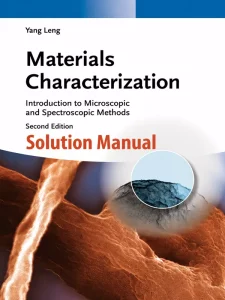
This product is the official Solution Manual of the textbook which covers all chapters 1 to 10. There is one PDF file for each of chapters which has 52 pages totally. This product has a total size of 1.29 MB. We recommend checking the sample file before completing your purchase.
Download Sample for Solution Manual for Materials Characterization by Yang Leng
List of Covered Chapters in the Solution Manual for Materials Characterization by Yang Leng
- Chapter 1 – Light Microscopy
- Chapter 2 – X-Ray Diffraction Methods
- Chapter 3 – Transmission Electron Microscopy
- Chapter 4 – Scanning Electron Microscopy
- Chapter 5 – Scanning Probe Microscopy
- Chapter 6 – X-Ray Spectroscopy for Elemental Analysis
- Chapter 7 – Electron Spectroscopy for Surface Analysis
- Chapter 8 – Secondary Ion Mass Spectrometry for Surface Analysis
- Chapter 9 – Vibrational Spectroscopy for Molecular Analysis
- Chapter 10 – Thermal Analysis
About the main textbook:
Materials Characterization: Introduction to Microscopic and Spectroscopic Methods, written by Yang Leng, is a comprehensive introductory textbook about the techniques used to examine the structure, composition, and properties of materials. Published by Wiley-VCH, the second edition is designed primarily for advanced undergraduate and postgraduate students in materials science, engineering, physics, chemistry, and related disciplines. It can also serve as a practical reference for researchers and laboratory professionals who need a clear introduction to modern characterization techniques.
The book explains how microscopic and spectroscopic methods help scientists understand materials at different scales. Its coverage ranges from visible microstructures to crystal defects, surface chemistry, elemental composition, molecular bonding, and thermal behavior. Students using the Solution Manual for Materials Characterization by Yang Leng can review the reasoning and analytical procedures associated with the book’s exercises while developing their understanding of these subjects.
The first part of the book concentrates on methods used to examine material structures. It begins with light microscopy, introducing optical principles, microscope instrumentation, specimen preparation, imaging modes, and confocal microscopy. These concepts provide the foundation required to understand how microstructural features can be observed and interpreted.
The discussion then moves to X-ray diffraction, an essential method for investigating crystalline materials. Topics include X-ray radiation, diffraction theory, X-ray diffractometry, crystal structures, and wide-angle X-ray diffraction and scattering. The Solution Manual for Materials Characterization by Yang Leng supports the study of diffraction principles through worked approaches to relevant exercises and technical problems.
Transmission electron microscopy is presented as a powerful technique for examining materials at very high resolution. The book discusses TEM instrumentation, specimen preparation, imaging modes, selected-area electron diffraction, and the observation of crystal defects. Students learn how electron beams interact with thin specimens and how the resulting images and diffraction patterns reveal structural information.
Scanning electron microscopy is also covered, with attention given to image formation, contrast mechanisms, and operational variables. The second edition adds important material on environmental scanning electron microscopy, which enables the examination of specimens under controlled environmental conditions. It also introduces electron backscatter diffraction, a widely used technique for studying crystal orientation, phase distribution, grain structure, and texture.
The section on scanning probe microscopy explains scanning tunneling microscopy and atomic force microscopy. It also discusses common imaging artifacts, helping readers distinguish genuine surface features from measurement-related distortions.
The second part focuses on techniques for identifying elemental and chemical characteristics. X-ray spectroscopy is explained through characteristic X-rays, X-ray fluorescence spectrometry, and energy-dispersive X-ray spectroscopy. Both qualitative and quantitative methods are introduced. Exercises associated with these analytical techniques can be studied with the Solution Manual for Materials Characterization by Yang Leng, especially when additional guidance is needed for calculations or interpretation.
The book then examines electron spectroscopy for surface analysis, including the basic principles of electron spectra and their use in identifying surface composition. Secondary ion mass spectrometry is discussed as another important surface-analysis method, with coverage of SIMS imaging, surface structure analysis, and depth profiling.
Vibrational spectroscopy receives substantial attention through Fourier transform infrared spectroscopy and Raman microscopy. These methods help identify chemical bonds, molecular structures, and phases by measuring characteristic vibrations. The book explains the theoretical background while emphasizing the interpretation of experimental spectra.
The final chapter covers thermal analysis, including differential thermal analysis, differential scanning calorimetry, and thermogravimetry. These methods are used to investigate phase transformations, thermal stability, melting behavior, reactions, and changes in mass as a function of temperature.
A major strength of the book is its balance between scientific theory and practical measurement. Mathematical and physical concepts are introduced without unnecessary complexity, while instrumentation, specimen preparation, data interpretation, and potential artifacts receive practical attention. The second edition includes revised and expanded material, approximately 20 percent new content, and 50 additional questions.
Overall, this textbook provides a structured introduction to the principal tools used for investigating materials. The Solution Manual for Materials Characterization by Yang Leng complements the textbook by helping students check their methods, understand problem-solving procedures, and strengthen their knowledge of microscopic, spectroscopic, surface, and thermal characterization.
You can find more information about the textbook in this link.
Please note that this product does not include the main textbook. It contains only the solution manual described above. Contact us with any questions.


