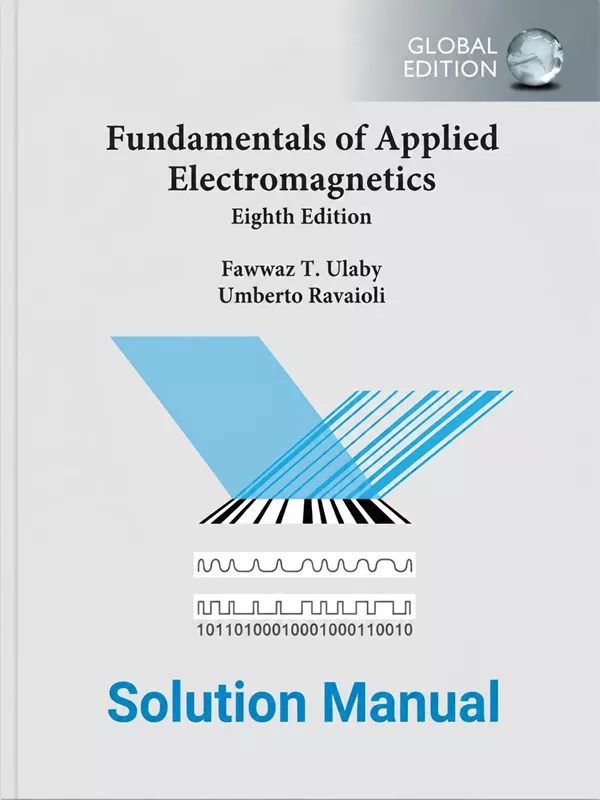
Solution Manual for Fundamentals of Applied Electromagnetics – Global Edition 8th Edition
Author: Fawwaz Ulaby, Umberto Ravaioli
Solution Manual for Fundamentals of Applied Electromagnetics by Ulaby is available for purchase here. Feel free to contact us with any questions or concerns.
This official resource package for the 8th Global Edition includes the complete Solution Manual, lecturer PowerPoint slides, and a guide to highlighted equations. Solution Manual for Fundamentals of Applied Electromagnetics by Ulaby is 656 pages long and covers all chapters from 1 to 10. Click [HERE] to view the full list of solved problems. This package also includes lecture slides for every chapter. The complete package is 656 MB. Feel free to examine the sample below prior to ordering.
Download Sample for Solution Manual for Fundamentals of Applied Electromagnetics by Ulaby
List of Covered Chapters in the Solution Manual for Fundamentals of Applied Electromagnetics by Ulaby (8th Gloabal Edition)
- Chapter 1 – Introduction: Waves and Phasors
- Chapter 2 – Transmission Lines
- Chapter 3 – Vector Analysis
- Chapter 4 – Electrostatics
- Chapter 5 – Magnetostatics
- Chapter 6 – Maxwell’s Equations for Time-Varying Fields
- Chapter 7 – Plane-Wave Propagation
- Chapter 8 – Wave Reflection and Transmission
- Chapter 9 – Radiation and Antennas
- Chapter 10 – Satellite Communication Systems and Radar Sensors
About the main textbook:
Fundamentals of Applied Electromagnetics by Fawwaz T. Ulaby and Umberto Ravaioli stands as one of the most widely respected and pedagogically sound textbooks in electrical and computer engineering education. Now in its 8th Global Edition, this authoritative text provides an accessible, mathematically rigorous, and physically intuitive introduction to electromagnetic (EM) fields and waves. Designed specifically for undergraduate engineering students, the book bridges the gap between abstract vector calculus and real-world engineering applications in high-frequency circuits, wireless communications, photonics, and radar systems.
Electromagnetics is traditionally considered one of the most challenging subjects in electrical engineering curricula due to its heavy reliance on multi-variable calculus, differential equations, and abstract field theory. Recognizing this barrier, Ulaby and Ravaioli employ a “transmission lines first” approach.
Rather than starting immediately with static electric and magnetic fields governed by Maxwell’s equations, the authors begin with transmission line theory. Transmission lines act as a conceptual bridge connecting familiar lumped-element circuit analysis (Kirchhoff’s laws, voltages, and currents) to distributed-element field analysis. This progression allows students to work with wave phenomena, reflection coefficients, impedance matching, and Smith Charts using concrete circuit concepts before transitioning to 3D vector fields. For learners tackling complex problem sets, having access to the Solution Manual for Fundamentals of Applied Electromagnetics by Ulaby provides clear, step-by-step guidance through these demanding derivations and impedance calculations.
The 8th Global Edition spans ten comprehensive chapters organized logically to build foundational knowledge:
- Introduction: Waves and Phasors: Establishes the mathematical framework, covering sinusoidal waves, complex numbers, phasor representations, and the electromagnetic spectrum.
- Transmission Lines: Explores wave propagation on lines, characteristic impedance, standing waves, voltage reflection coefficients, and graphical design using the Smith Chart.
- Vector Analysis: Develops vector algebra, coordinate transformations (Cartesian, cylindrical, and spherical), gradient, divergence, curl, and fundamental theorems like Stokes’ and Divergence theorems.
- Electrostatics: Focuses on stationary charges, Coulomb’s law, Gauss’s law, electric potential, boundary conditions between different media, capacitance, and electrostatic energy.
- Magnetostatics: Covers steady currents, Biot-Savart law, Ampère’s circuital law, magnetic vector potential, boundary conditions, inductance, and magnetic materials.
- Maxwell’s Equations for Time-Varying Fields: Synthesizes electromagnetic theory by introducing Faraday’s law, Maxwell-Ampère law with displacement current, boundary conditions, and energy flow through the Poynting vector.
- Plane-Wave Propagation: Analyzes time-harmonic plane waves in lossless, lossy, and conducting media, including skin effect, polarization states, and wave incidence on planar boundaries.
- Wave Reflection and Transmission: Details Snell’s laws, Brewster’s angle, critical angle phenomena, total internal reflection, and fiber-optic waveguiding principles.
- Radiation and Antennas: Introduces antenna fundamentals such as radiation resistance, directivity, gain, radiation patterns, dipole antennas, and Friis transmission equations.
- Satellite Communication and Radar Systems: Connects theory to practical technology, examining link budgets, radar cross-sections, Doppler radar, and satellite transponders.
Key Features of the 8th Global Edition
- Interactive Simulations and Technology Briefs: The textbook integrates practical “Technology Briefs” that explain modern applications like RFID, liquid crystal displays (LCDs), GPS, magnetic resonance imaging (MRI), and 5G networks.
- Modernized Problem Sets: Hundreds of updated review problems, end-of-chapter exercises, and design scenarios help students test their analytical capabilities. Utilizing the Solution Manual for Fundamentals of Applied Electromagnetics by Ulaby enables students to verify their solutions and master problem-solving techniques for homework and exam prep.
- Global Relevance: As a Global Edition, the text uses international standard notation and units (SI), featuring applications and examples relevant to engineering students worldwide.
Fundamentals of Applied Electromagnetics is primarily aimed at junior-level undergraduate students in electrical engineering, computer engineering, and applied physics. It is also an invaluable reference text for practicing RF (radio frequency), microwave, and antenna design engineers who need to revisit fundamental electromagnetic concepts.
Because the mathematical formulations—especially boundary-value problems and wave reflection equations—require rigorous practice, self-directed learners often rely on verified study aids. In this context, the Solution Manual for Fundamentals of Applied Electromagnetics by Ulaby acts as an essential companion resource, ensuring thorough comprehension of core principles.
The 8th Global Edition of Fundamentals of Applied Electromagnetics by Fawwaz Ulaby and Umberto Ravaioli remains a cornerstone textbook in modern engineering education. Its systematic pedagogy, clear explanations, and strong emphasis on practical applications prepare students for advanced study and industrial work in communications, signal integrity, and microwave technologies. For educators and students seeking complete academic mastery, pairing the textbook with the official Solution Manual for Fundamentals of Applied Electromagnetics by Ulaby delivers a complete, dependable framework for electromagnetic study.
You can find more information about the textbook in this link.
Important: the original textbook is not part of this listing. You will receive the Solution Manual only + Lecturer’s PowerPoint slides as detailed above. Feel free to reach out if anything is unclear.