
Solution Manual for Aerodynamics for Engineers – 7th, 6th and 5th edition
Authors: John J. Bertin, Russell M. Cummings
This page is a reference page for Solution Manual for Aerodynamics for Engineers by Bertin and Cummings and You can access Solution Manual for 7th, 6th and 5th Editions right here. Have questions? We are just a message away.”
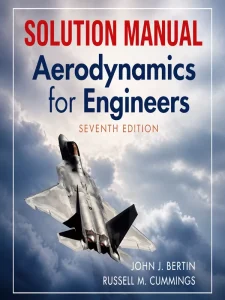
First product is official resources for 7th Edition which includes Solutions Manual, Answers to Select Problems, Code, Lecture Slides, Links, Programs + Figures and Tables. This product will be available on the site soon.
Download Sample for Solution Manual for Aerodynamics for Engineers 7th Edition by Bertin and Cummings
Second product is official Solution Manual for 6th Edition. The Solution Manual is a PDF file with 330 pages which covers all chapters 1 to 13. File size: 59.3 MB. Please take a moment to look at the sample before buying.
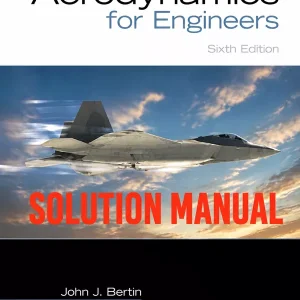
The third product is the official Solution Manual for the 5th Edition, covering Chapters 1 through 11. It includes one PDF file for each chapter, for a total of 321 pages. Please note that some sections of the solution manual are scanned handwritten pages. Total size: 13.4 MB. Please verify the content using the sample below before purchasing.
List of covered chapters in Solution Manual for Aerodynamics for Engineers by Bertin and Cummings (7th Edition)
- Chapter 1 – Why Study Aerodynamics?
- Chapter 2 – Fundamentals of Fluid Mechanics
- Chapter 3 – Dynamics of an Incompressible, Inviscid Flow Field
- Chapter 4 – Viscous Boundary Layers
- Chapter 5 – Characteristic Parameters for Airfoil and Wing Aerodynamics
- Chapter 6 – Incompressible Flows Around Airfoils of Infinite Span
- Chapter 7 – Incompressible Flow About Wings of Finite Span
- Chapter 8 – Dynamics of a Compressible Flow Field
- Chapter 9 – Compressible, Subsonic Flows and Transonic Flows
- Chapter 10 – Two-Dimensional, Supersonic Flows Around Thin Airfoils
- Chapter 11 – Supersonic Flows Over Wings and Airplane Configurations
- Chapter 12 – Hypersonic Flows
- Chapter 13 – Aerodynamic Design Considerations
- Chapter 14 – Tools for Defining the Aerodynamic Environment
About the main textbook:
Aerodynamics for Engineers, 7th edition by John J. Bertin and Russell M. Cummings is a well-known textbook for students and professionals who want a solid, practical understanding of aerodynamics. It is widely used in aerospace engineering courses because it combines theory, engineering intuition, and real-world applications in a way that is easier to follow than many highly theoretical texts. The book focuses on how air moves around bodies, how lift and drag are generated, and how engineers analyze flow behavior for aircraft and other vehicles.
The main strength of the book is that it explains aerodynamic principles from a problem-solving perspective. Instead of presenting only abstract equations, it connects the math to engineering design and performance. Readers learn about fundamental topics such as fluid properties, conservation laws, potential flow, boundary layers, compressibility, airfoil theory, and wing theory. It also covers subsonic, transonic, and supersonic flow, which makes it useful for understanding a broad range of flight conditions.
For students, the 7th edition is especially helpful because the authors build concepts step by step. Early chapters introduce the basics of fluid mechanics and aerodynamic forces, then later chapters move into more advanced topics like viscous effects, shock waves, and high-speed aerodynamics. This structure helps readers develop confidence before moving to more difficult material. The book also includes examples, figures, and end-of-chapter problems that reinforce learning and prepare students for exams and design work.
One reason many students search for Solution Manual for Aerodynamics for Engineers by Bertin and Cummings is that the textbook can be challenging, especially when working through derivations and numerical problems. A solution manual can help learners check their work, understand problem-solving methods, and identify where they made mistakes. It is often used as a study aid for homework, quizzes, and test preparation. Solution Manual for Aerodynamics for Engineers by Bertin and Cummings is therefore a popular companion resource for anyone studying this subject.
In a broader sense, Solution Manual for Aerodynamics for Engineers by Bertin and Cummings supports independent learning by showing how textbook problems are solved in detail. This is useful not only for students, but also for instructors and tutors who want a reference while teaching aerodynamic concepts. Because the book itself contains many technical problems, having a guide to the solutions can save time and make difficult material easier to master.
The 7th edition also reflects the continuing importance of aerodynamics in modern engineering. Aerodynamic design is essential in aircraft, drones, spacecraft entry, wind engineering, and even automotive applications. That is why this text remains relevant: it teaches principles that can be applied far beyond a single classroom course. Readers who understand the material can better analyze performance, improve efficiency, and make informed design decisions.
If you are studying aerospace or mechanical engineering, this book is a strong foundation for learning how fluids interact with moving bodies. It is especially valuable for students who need both conceptual understanding and practical calculation skills. For many learners, Solution Manual for Aerodynamics for Engineers by Bertin and Cummings becomes an important support tool alongside the textbook itself. And for those preparing assignments or exams, Solution Manual for Aerodynamics for Engineers by Bertin and Cummings can make the difference between memorizing formulas and truly understanding the subject.
Overall, Aerodynamics for Engineers 7th edition is a respected and useful textbook that explains aerodynamic theory in a clear, engineering-focused way. It is a strong choice for anyone who wants to learn how aerodynamic forces work and how engineers apply those principles in real design problems.
You can find more information about the textbook in this link.
Please note upper products come with Solution Manuals + other mentioned resources. Main textbooks are not part of upper products. Please contact us if you need further clarification.