
Solution Manual for Engineering Dynamics: A Basic Introduction
Author: Keith D. Hjelmstad
The comprehensive Solution Manual for Engineering Dynamics by Keith Hjelmstad is available here. Please contact us for further details.
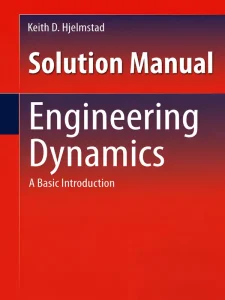
This product is the official Solution Manual of the textbook which covers all chapters 1 to 8. The Solution Manual is a PDF file with 455 pages. This product has a total size of 4.4 MB. We recommend checking the sample file before purchasing.
Download Sample for Solution Manual for Engineering Dynamics by Keith Hjelmstad
List of Covered Chapters in the Solution Manual for Engineering Dynamics by Keith Hjelmstad
- Chapter 1 – Vectors
- Chapter 2 – Particle Mechanics
- Chapter 3 – Rigid Body Motion in a Plane
- Chapter 4 – Unifying Concepts for Planar Motion
- Chapter 5 – Motion in Three Dimensions
- Chapter 6 – Euler–Lagrange Equations
- Chapter 7 – Impact
- Chapter 8 – Vibrations
About the main textbook:
Engineering Dynamics: A Basic Introduction by Keith D. Hjelmstad is an undergraduate engineering textbook that presents the fundamental principles used to describe and analyze motion. Designed primarily for second-year engineering students, the book develops dynamics through a structured combination of vector mathematics, physical laws, analytical methods, and practical problem-solving techniques. It covers both particle and rigid-body dynamics while emphasizing a consistent framework that students can apply to a wide range of engineering problems.
The book begins with a review of vectors, establishing the mathematical language required for later chapters. Vector notation is used throughout the text to represent position, velocity, acceleration, force, momentum, and other physical quantities. This approach helps students understand dynamics in a form that can be extended naturally from two-dimensional problems to three-dimensional motion. Students seeking additional support while studying these foundations may use the Solution Manual for Engineering Dynamics by Keith Hjelmstad to examine solution methods and check their understanding.
Particle mechanics is one of the book’s central subjects. It introduces the kinematics of particles, including position, displacement, velocity, and acceleration, before connecting motion to forces through Newton’s laws. The discussion also includes important methods based on work and energy, impulse and momentum, and angular momentum. These principles provide alternative ways to solve dynamics problems, especially when a direct force-and-acceleration analysis becomes lengthy or inconvenient.
The text then develops the motion of rigid bodies in a plane. Students learn how translation, rotation, and general planar motion are related, as well as how the velocity and acceleration of different points on a rigid body can be determined. These concepts are essential for analyzing mechanisms, rotating components, vehicles, and many other mechanical and structural systems. The Solution Manual for Engineering Dynamics by Keith Hjelmstad can complement this material by showing how equations, diagrams, and physical assumptions are organized during problem solving.
A notable part of the book is its effort to unify the major concepts used in planar motion. Instead of presenting every method as an isolated procedure, Hjelmstad emphasizes the relationships among kinematics, forces, energy, momentum, and angular momentum. This integrated treatment encourages students to choose a solution strategy based on the structure of a problem rather than relying on memorized formulas.
The book also extends the analysis to motion in three dimensions. Three-dimensional rigid-body motion is more demanding because vectors can change both magnitude and direction, while angular quantities require careful interpretation. The text provides the mathematical foundation needed to study spatial rotation, angular velocity, angular acceleration, and the dynamic behavior of bodies moving in space. Worked guidance from the Solution Manual for Engineering Dynamics by Keith Hjelmstad may help readers follow the multi-step calculations involved in these advanced topics.
Another important chapter introduces the Euler-Lagrange equations. This formulation offers an energy-based approach to mechanics and is particularly useful for systems with generalized coordinates or constraints. By including this topic, the book connects introductory engineering dynamics with more advanced subjects such as analytical mechanics, robotics, structural dynamics, and control-system modeling.
Later chapters address impact and vibrations. The impact material examines collisions, impulsive forces, momentum changes, and the behavior of interacting bodies over short time intervals. The vibrations chapter introduces oscillatory motion and the response of basic mechanical systems. These subjects have direct applications in machine design, structural engineering, vehicle behavior, and mechanical-system safety.
The book also incorporates computational work, including the use of MATLAB to solve equations, explore nonlinear behavior, and visualize dynamic systems. This combination of analytical theory and numerical computation reflects modern engineering practice, where closed-form calculations are often supported by computational models.
Overall, Engineering Dynamics: A Basic Introduction provides a broad foundation in particle motion, rigid-body mechanics, three-dimensional dynamics, analytical mechanics, impact, and vibrations. Its vector-based presentation and unified problem-solving approach make it suitable for engineering students who have studied calculus, linear algebra, and differential equations. Used responsibly as a study aid, the Solution Manual for Engineering Dynamics by Keith Hjelmstad can support practice, clarify complex procedures, and help students evaluate their progress while working through the textbook’s exercises.
You can find more information about the textbook in this link.
Please note: This product does not include the main textbook. It contains only the solution manual described above. Please contact us with any questions.


