Solution Manual for An Introduction to Mathematical Thinking: Algebra and Number Systems
Authors: William J. Gilbert, Scott A. Vanstone
This page offers the Solution Manual for An Introduction to Mathematical Thinking by Gilbert and Vanstone. Feel free to reach out if you need any assistance.
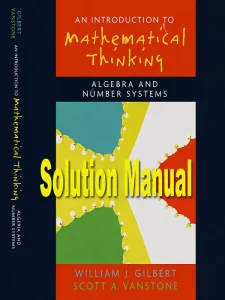
This product is official Solution Manual of the book which covers chapters 1 to 9. There is one PDF file for each of chapters that has 450 pages totally. The download size is 2.06 MB. You may review the sample below prior to purchase.
List of Covered Chapters in the Solution Manual for An Introduction to Mathematical Thinking by Gilbert and Vanstone
- Chapter 1 – Logic and Proofs
- Chapter 2 – Integers and Diophantine Equations
- Chapter 3 – Congruences
- Chapter 4 – Induction and the Binomial Theorem
- Chapter 5 – Rational and Real Numbers
- Chapter 6 – Functions and Bijections
- Chapter 7 – An Introduction to Cryptography
- Chapter 8 – Complex Numbers
- Chapter 9 – Polynomial Equations
About the main textbook:
An Introduction to Mathematical Thinking: Algebra and Number Systems by William J. Gilbert and Scott A. Vanstone is a well‑known textbook designed to help students move from routine calculation to deeper mathematical reasoning. Rather than focusing only on formulas and procedures, the book encourages readers to understand how mathematicians think, how proofs are constructed, and how abstract ideas in algebra and number systems are developed. It is especially useful for students who are beginning higher‑level mathematics and need to strengthen their logical and analytical skills.
One of the main strengths of this book is its emphasis on mathematical thinking itself. Many students enter advanced mathematics courses with experience in computation but limited exposure to formal reasoning. Gilbert and Vanstone address this challenge by carefully introducing the language of logic, sets, relations, functions, and proof techniques. Readers learn not only what mathematical statements mean, but also how to justify them clearly and rigorously. This foundation is essential for success in algebra, number theory, discrete mathematics, and many other branches of mathematics.
The algebra portion of the book helps students understand important structures and concepts rather than simply manipulating symbols. Topics are presented in a way that develops understanding step by step, allowing readers to see how abstract algebraic ideas arise naturally from simpler patterns and rules. The treatment of number systems also plays a central role, showing how different systems are defined, how their properties are established, and how they connect to broader mathematical theory. Through this approach, the book helps students build confidence in handling abstraction.
Another important feature of the text is its use of examples and exercises that encourage active thinking. Instead of relying only on memorization, students are challenged to test ideas, analyze statements, and construct proofs. This makes the book particularly valuable for teacher education programs and for students preparing for more advanced university mathematics. By working through the material carefully, readers develop the habits of precision and logical reasoning that are central to mathematical study.
The book is also appreciated for its accessible writing style. Although the ideas can be abstract, the authors explain them in a structured and readable way. This makes the text suitable for independent learners as well as classroom use. Students who may initially feel intimidated by proof‑based mathematics often find that the book provides a gentler introduction to rigorous thinking than many traditional advanced texts.
Because the material emphasizes proof, abstraction, and conceptual understanding, some students benefit from additional study resources when working through the exercises. The Solution Manual for An Introduction to Mathematical Thinking by Gilbert and Vanstone can be a useful companion for readers who want to check their reasoning and better understand problem‑solving methods. It provides guidance on how certain problems may be approached and helps learners see how mathematical arguments are organized.
For students transitioning into proof‑based mathematics, the Solution Manual for An Introduction to Mathematical Thinking by Gilbert and Vanstone can support the learning process by clarifying difficult exercises and reinforcing key concepts in algebra and number systems. By studying worked solutions, learners can better understand how to write clear mathematical arguments and develop stronger analytical skills.
Overall, An Introduction to Mathematical Thinking: Algebra and Number Systems is an excellent text for building the foundations of higher mathematics. Its careful treatment of logic, proof, algebra, and number systems makes it a valuable resource for students and educators alike. When used alongside the Solution Manual for An Introduction to Mathematical Thinking by Gilbert and Vanstone, the book can become an even more effective tool for mastering the principles of mathematical reasoning.
You can find more information about the textbook in this link.
This product does not include the main textbook. It contains only the Solution Manual described above. If you have any questions, do not hesitate to contact us.