
Solution Manual for Introduction to Mathematical Programming: Operations Research Vol. 1 – 4th Edition
Authors: Wayne L. Winston, Munirpallam Venkataramanan
The Solution Manual for Introduction to Mathematical Programming by Winston and Venkataramanan is available for purchase on this page. Have a question? We’re here to help — just contact us.
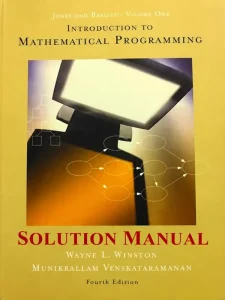
This product contains the official 4th Edition resources: the Solution Manual, PowerPoint presentations, and case solutions & suggestions. The Solution Manual covers chapters 2 through 16, with one Word file per chapter (536 pages total); a complete PDF version of the Solution Manual is also included. The Solution Manual folder additionally contains more than 50 Excel files. Lecture slides from two different lecturers are provided for all chapters, and a “Case solutions & suggestions” folder is included with several Word and Excel files. Total size is 20.3 MB. Please review the sample below before purchasing.
List of Covered Chapters in the Solution Manual for Introduction to Mathematical Programming by Winston and Venkataramanan (4th Edition)
- Chapter 1 – Introduction To Model Building (not covered in the Solution Manual)
- Chapter 2 – Basic Linear Algebra
- Chapter 3 – Introduction To Linear Programing
- Chapter 4 – The Simplex Algoritm And Goal Programing
- Chapter 5 – Sensitivity Analysis: An Applied Approach
- Chapter 6 – Sensitivity Analysis And Duality
- Chapter 7 – Transportation, Assignment, And Transshipment Problems
- Chapter 8 – Network Models
- Chapter 9 – Integer Programming
- Chapter 10 – Advanced Topics In Linear Programming
- Chapter 11 – Game Theory
- Chapter 12 – Nonlinear Programming
- Chapter 13 – Deterministic Dynamic Programming
- Chapter 14 – Heuristic Techniques
- Chapter 15 – Solving Optimization Problems with the Evolutionary Solver
- Chapter 16 – Neural Networks
About the main textbook:
Introduction to Mathematical Programming, Operations Research, Vol. 1 is one of the most widely adopted textbooks for teaching deterministic operations research, optimization, and mathematical programming to undergraduate and graduate students in engineering, business, mathematics, and computer science. Authored by Wayne L. Winston, a legendary professor and teacher in the field of management science, and Munirpallam Venkataramanan of Indiana University’s Kelley School of Business, the fourth edition refines a text that has set the standard for clarity and application-driven learning in operations research.
The book focuses on deterministic operations research — the art and science of making optimal decisions using mathematical models. Unlike its companion Volume 2, which covers probabilistic and stochastic topics such as queuing, Markov chains, and simulation, this first volume is devoted almost entirely to optimization: linear programming, integer programming, network models, and related techniques. The unifying theme is that virtually any decision problem involving limited resources can be formulated as a mathematical model and solved to find the best possible course of action.
The text opens with an introduction to the modeling process itself — how to translate a real business or engineering problem into variables, constraints, and an objective function. Winston and Venkataramanan emphasize throughout that formulation is as important as solution, because a poorly formulated model cannot yield meaningful answers no matter how sophisticated the solver.
The heart of the book is linear programming (LP). The authors develop the simplex method step by step, from geometric intuition through algebraic implementation, and then explore its far-reaching consequences: sensitivity analysis, duality theory, and the interpretation of shadow prices. These chapters teach students not just how to solve an LP, but what the solution means and how it changes when the problem’s data change.
The book then expands into a broad family of optimization tools. Integer programming is treated in depth, with branch-and-bound, cutting plane methods, and the formulation of binary and mixed-integer models for problems like capital budgeting, facility location, and set covering. Network models receive extensive coverage, including the shortest path problem, maximum flow problem, minimum spanning tree, transportation problem, assignment problem, and transshipment problem. A full treatment of dynamic programming shows how complex sequential decisions can be solved recursively.
Beyond pure optimization, the volume introduces other deterministic decision tools: nonlinear programming with golden section search, Lagrange multipliers, and the Kuhn-Tucker (KKT) conditions; goal programming and multiobjective optimization for problems with conflicting objectives; deterministic inventory models such as the economic order quantity (EOQ); game theory; and decision analysis with decision trees and expected value criteria. The book also covers project scheduling through the critical path method (CPM) and PERT.
A defining feature of Winston’s approach is the integration of computer software directly into the learning process. The fourth edition shows how to implement models in spreadsheet solvers such as Excel Solver and in dedicated optimization packages, historically LINDO and LINGO, and it encourages students to read and interpret solver output rather than solve problems by hand alone. Hundreds of realistic case studies and end-of-chapter problems — drawn from production planning, advertising, logistics, finance, agriculture, energy, and more — ground each technique in genuine applications.
The fourth edition modernizes and streamlines the classic text. The presentation has been reorganized for smoother flow, examples have been updated, and the role of spreadsheets as a modeling tool is expanded to reflect how optimization is actually practiced in industry. The authors sharpen their trademark style: clear prose, worked examples at every step, and an emphasis on intuitive understanding of the mathematics. Each chapter builds from simple examples to complex applications, so students develop both confidence and depth.
This book is aimed primarily at upper-level undergraduates and graduate students in industrial engineering, operations research, management science, business analytics, applied mathematics, and computer science. It is equally valuable to practicing analysts and managers who need a rigorous yet accessible reference for optimization modeling. A working knowledge of linear algebra and calculus is assumed, but the authors review prerequisite mathematics where needed.
Because the text is problem-driven, students frequently work through extensive end-of-chapter exercises to master both formulation and solution. Many learners therefore seek the Solution Manual for Introduction to Mathematical Programming by Winston and Venkataramanan to verify their formulations and check their numerical answers. A complete Solution Manual for Introduction to Mathematical Programming by Winston and Venkataramanan is especially useful because the book’s problems often require careful modeling decisions, and a single sign or constraint error can derail an entire solution. Instructors and students commonly rely on the Solution Manual for Introduction to Mathematical Programming by Winston and Venkataramanan as a self-assessment and teaching aid that matches the text’s notation, methods, and problem structure exactly. For those preparing for exams or teaching the course, the Solution Manual for Introduction to Mathematical Programming by Winston and Venkataramanan provides consistent, fully worked solutions that reinforce the step-by-step modeling approach Winston and Venkataramanan teach.
In short, Introduction to Mathematical Programming, Operations Research, Vol. 1, 4th Edition is a definitive, application-oriented introduction to deterministic optimization. Winston and Venkataramanan’s clarity, breadth of topics, and mathematical rigor. make it an ideal text for anyone seeking to model and solve real-world decision problems with mathematical rigor.
You can find more information about the textbook in this link.
Important: the main textbook is not included. This download contains the Solution Manual + other resources as described above. Contact us with any questions.


