
Solution Manual for An Introduction to Combustion: Concepts and Applications 3rd Edition
Author: Stephen R. Turns
Purchase the Solution Manual for An Introduction to Combustion by Turns right here. Questions? Please don’t hesitate to contact us.
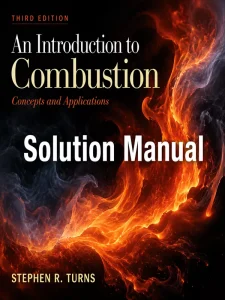
This product is official solution manual for 3rd edition which covers all chapters of the textbook (chapter 2 to 17). It most notified the solution manual is handwritten. The Solution Manual is in PDF format and has 384 pages. File size: 7.54 MB. Feel free to preview the sample below to ensure it meets your needs before buying.
Download Sample for Solution Manual for An Introduction to Combustion by Turns
List of Covered Chapters in the Solution Manual for An Introduction to Combustion by Turns
- Chapter 2 – Combustion and Thermochemistry
- Chapter 3 – Introduction to Mass Transfer
- Chapter 4 – Chemical Kinetics
- Chapter 5 – Some Important Chemical Mechanisms
- Chapter 6 – Coupling Chemical and Thermal Analyses of Reacting Systems
- Chapter 7 – Simplified Conservation Equations for Reacting Flows
- Chapter 8 – Laminar Premixed Flames
- Chapter 9 – Laminar Diffusion Flames
- Chapter 10 – Droplet Evaporation and Burning
- Chapter 11 – Introduction to Turbulent Flows
- Chapter 12 – Turbulent Premixed Flames
- Chapter 13 – Turbulent Nonpremixed Flames
- Chapter 14 – Burning of Solids
- Chapter 15 – Emissions
- Chapter 16 – Detonations
- Chapter 17 – Fuels
About the main textbook:
An Introduction to Combustion: Concepts and Applications, 3rd Edition by Stephen R. Turns is a well-known textbook in mechanical and chemical engineering, especially for students and professionals who want a solid foundation in combustion science. It explains how combustion works from both a physical and chemical perspective, making it useful for understanding real-world systems such as engines, gas turbines, furnaces, rockets, and industrial burners.
The book is valued because it balances theory and application. Stephen R. Turns introduces the core principles of thermodynamics, chemical kinetics, fluid mechanics, heat transfer, and mass transfer, then shows how these principles interact in combustion processes. Instead of treating combustion as only a chemistry topic, the text presents it as a multidisciplinary engineering subject.
A major strength of the book is its clear structure. It typically begins with the fundamentals of fuels, combustion chemistry, and energy release. From there, it moves into topics such as flame speed, premixed and diffusion flames, ignition, droplet and particle combustion, and pollutant formation. It also discusses practical concerns like nitrogen oxides, carbon monoxide, soot, and strategies for cleaner combustion. This makes the book especially relevant for modern energy and environmental studies.
Another important feature is its engineering focus. The text does not only define concepts; it also applies them to devices and systems engineers actually design or analyze. Readers learn why combustion stability matters, how flame temperature affects efficiency and emissions, and what parameters influence the performance of combustion equipment. Because of this, the book is often used in upper-level undergraduate courses, graduate study, and professional reference work.
The 3rd edition is appreciated for refining explanations, updating examples, and presenting problem-solving methods in a more accessible way. End-of-chapter problems help readers test their understanding and build quantitative skills. Many students use the book not only for coursework but also for research preparation and technical interviews in thermal sciences and energy engineering.
For students, one of the biggest advantages is that the text connects mathematical models with physical intuition. Complex topics like adiabatic flame temperature, equilibrium combustion analysis, and reaction mechanisms are explained in a way that helps readers see both the equations and the engineering meaning behind them. That makes it easier to move from classroom learning to practical application.
Because of its reputation, many learners search for extra study resources alongside the textbook, including the Solution Manual for An Introduction to Combustion by Turns. Such resources can help students check problem-solving steps, understand difficult derivations, and prepare more effectively for exams. In academic support markets, the Solution Manual for An Introduction to Combustion by Turns is especially attractive to engineering students who need guided practice.
Overall, this book is considered a strong introduction to combustion engineering because it combines scientific depth, practical relevance, and readable presentation. Whether someone is studying internal combustion engines, energy systems, fire science, or emissions control, it offers a reliable starting point. That is why the Solution Manual for An Introduction to Combustion by Turns is often searched together with the textbook, and why the Solution Manual for An Introduction to Combustion by Turns remains a highly relevant companion keyword for students looking for academic support.
You can find more information about the textbook in this link.
Please note that this product does not contain the main textbook. It includes only the Solution Manual as mentioned above. Our team is available to assist you; please reach out if you have any inquiries.


