Solution Manual for Craig’s Soil Mechanics 9th Edition
Authors: R.F. Craig, Jonathan A. Knappett
This page offers the Solution Manual for Soil Mechanics by Craig. Have questions? Feel free to contact our support team if you have any questions regarding this product.
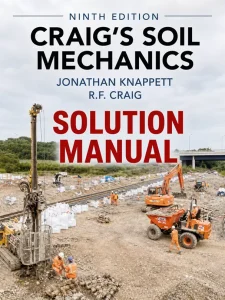
This product is the official Solution Manual for 9th Edition which covers all chapters 1 to 12 of the book. The solution Manual is in PDF format and has 153 pages. This file is 10.3 MB. We recommend reviewing the provided sample before proceeding with your download
Download Sample for Solution Manual for Soil Mechanics by Craig
List of Covered Chapters in the Solution Manual for Soil Mechanics by Craig
- Chapter 1 – Basic characteristics of soils
- Chapter 2 – Seepage
- Chapter 3 – Effective stress
- Chapter 4 – Consolidation
- Chapter 5 – Soil behaviour in shear
- Chapter 6 – Ground investigation
- Chapter 7 – In-situ testing
- Chapter 8 – Shallow foundations: capacity
- Chapter 9 – Shallow foundations: serviceability
- Chapter 10 – Deep foundations
- Chapter 11 – Retaining structures
- Chapter 12 – Earthworks
About the main textbook:
Craig’s Soil Mechanics, 9th Edition by R.F. Craig and Jonathan A. Knappett is a widely respected textbook in the field of geotechnical engineering. It provides a clear and structured introduction to the principles that govern soil behavior, making it suitable for undergraduate civil engineering students, postgraduate learners, and practicing engineers who need a reliable reference for soil mechanics concepts.
The book covers the essential foundations of soil mechanics, including soil classification, phase relationships, permeability, seepage, consolidation, shear strength, stress distribution, earth pressure, slope stability, and bearing capacity. One of its strengths is the way it connects theoretical principles with engineering applications. Instead of presenting soil mechanics only as abstract theory, the text explains how soil behavior affects real-world structures such as foundations, retaining walls, embankments, slopes, and earth dams.
A major feature of the 9th edition is its modernized approach to geotechnical analysis. Jonathan A. Knappett’s contribution helps update the classic Craig material with contemporary engineering methods and clearer explanations of practical design problems. The book balances mathematical treatment with conceptual understanding, allowing students to learn not only how to solve problems but also why particular methods are used.
Solution Manual for Soil Mechanics by Craig is often searched by students who want additional guidance when working through the textbook’s exercises. The textbook itself includes many worked examples and end-of-chapter problems that help reinforce learning. These problems are especially valuable because soil mechanics requires both calculation skills and engineering judgment. Topics such as effective stress, settlement, shear strength testing, and foundation design often involve step-by-step reasoning, so practice is essential.
The book begins with basic soil properties and classification systems, helping readers understand how soils are described and grouped according to particle size, plasticity, and engineering behavior. It then moves into water flow through soil, introducing concepts such as Darcy’s law, permeability testing, seepage forces, and flow nets. These chapters are important for analyzing groundwater movement and problems involving uplift pressure or piping.
Another important part of the book is consolidation and settlement analysis. These sections explain how saturated clay soils deform over time when subjected to loading. Students learn about one-dimensional consolidation theory, compression indices, coefficient of consolidation, and settlement prediction. These ideas are critical in foundation engineering because excessive settlement can damage structures even if bearing capacity failure does not occur.
Solution Manual for Soil Mechanics by Craig can support learners in checking their understanding of these calculation-heavy chapters. The book’s treatment of shear strength is also central to geotechnical engineering. It explains the Mohr-Coulomb failure criterion, drained and undrained strength, triaxial testing, direct shear testing, and the interpretation of laboratory results. These concepts are later applied to slope stability, lateral earth pressure, and foundation bearing capacity.
The chapters on earth pressure and retaining structures are particularly practical. They introduce Rankine and Coulomb earth pressure theories and show how soil pressure acts on retaining walls and similar structures. The textbook also discusses stability considerations such as sliding, overturning, and bearing resistance. For students preparing for exams or design coursework, these chapters are among the most important.
Solution Manual for Soil Mechanics by Craig is relevant because many of the textbook’s exercises combine several concepts at once. For example, a foundation problem may require understanding stress distribution, consolidation settlement, and shear strength parameters. This integrated style reflects real engineering practice, where soil behavior is rarely limited to one simple variable.
Craig’s Soil Mechanics, 9th Edition remains popular because it is rigorous without being unnecessarily complicated. It provides enough theoretical depth for academic study while staying focused on civil engineering applications. The writing style is clear, the diagrams are useful, and the examples help readers develop confidence in solving geotechnical problems.
Overall, this textbook is an important resource for anyone studying or working in geotechnical engineering. It builds a strong foundation in soil behavior and prepares readers for more advanced study in foundation engineering, ground improvement, geotechnical design, and numerical analysis. Solution Manual for Soil Mechanics by Craig is commonly associated with the book because students often seek step-by-step help to master its technical exercises and strengthen their problem-solving skills.
You can find more information about the textbook in this link.
Important Note: Please note this is not the main textbook. This file includes the Solution Manual as described above. If you have questions about this Solution Manual or our Test Bank offerings, please contact us.