Solution Manual for Hydrology: Water Quantity and Quality Control – 2nd Edition
Authors: Martin P. Wanielista, Robert Kersten and Ron Eaglin
This product page offers the Solution Manual for Hydrology by Wanielista & Kersten. Our team is available to answer any questions you may have.
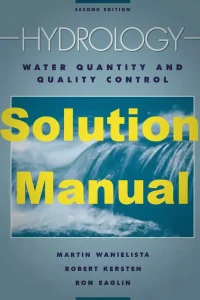
This product is official resources for 2nd Edition which includes Solution Manual and Hydrology Software. Solution Manual for Hydrology by Wanielista & Kersten covers chapters 1 to 10 and has 269 pages. The complete file size is 22 MB. We recommend checking the sample first.
Download Sample for Solution Manual for Hydrology by Wanielista and Kersten
Skip to PDF contentAbout the main textbook:
Hydrology: Water Quantity and Quality Control (2nd Edition) by Martin P. Wanielista, Robert Kersten, and Ron Eaglin is a comprehensive textbook that combines the study of water movement with practical methods for managing both water quantity and water quality. The book is widely used in environmental engineering, civil engineering, and water resources programs due to its strong balance between theory, design, and real‑world application.
The authors begin by introducing the fundamental principles of the hydrologic cycle, including precipitation, evaporation, infiltration, runoff, and groundwater flow. Rather than treating these topics abstractly, the text emphasizes how natural processes interact with engineered systems. This helps students develop a systems‑level understanding of how water behaves in urban, rural, and natural environments.
A major strength of the book is its focus on water quantity control, particularly in the context of stormwater management. Topics such as rainfall analysis, watershed modeling, flood routing, and detention and retention systems are explained clearly and supported by worked examples. Engineers and students learn how to estimate peak discharges, design drainage systems, and evaluate flood risks using accepted hydrologic methods. For learners working through problem sets, the Solution Manual for Hydrology by Wanielista & Kersten plays an important role in clarifying calculation steps and reinforcing correct problem‑solving techniques.
Equally important is the book’s detailed treatment of water quality control. The authors address pollutants commonly found in surface runoff, groundwater, and wastewater, and explain how land use and human activity affect water quality. The text covers regulatory considerations, best management practices (BMPs), and treatment techniques used to reduce pollution loads. This integrated approach helps readers understand that water quantity and water quality cannot be managed independently, a concept that is central to modern environmental engineering practice.
The second edition expands on design methods, real‑world case studies, and applied examples, making it particularly valuable for practicing engineers as well as students. Spreadsheet‑based calculations, design charts, and simplified modeling techniques are used throughout the book, allowing readers to connect academic concepts directly to engineering decisions. When used alongside the Solution Manual for Hydrology by Wanielista & Kersten, readers can verify their solutions and gain confidence in applying hydrologic equations correctly.
Overall, Hydrology: Water Quantity and Quality Control serves as both an instructional textbook and a practical reference. Its clear explanations, structured problem sets, and emphasis on applied design make it well‑suited for coursework, professional exam preparation, and real engineering projects. For those seeking deeper understanding and step‑by‑step guidance, the Solution Manual for Hydrology by Wanielista & Kersten remains a valuable companion resource that enhances learning and supports accurate application of the book’s methods.
You can find more information about the textbook in this link.
This item does not include the original textbook and provides Solution Manual + Hydrology Software as described above. You’re welcome to contact us for further information.