Solution Manual for Introduction to Embedded Systems: A Cyber-Physical Systems Approach – 2nd and 1st Edition
Authors: Edward Ashford Lee, Sanjit Arunkumarr Seshia
Solutions for Introduction to Embedded Systems for 2nd and 1st Editions are sold on this page. Have questions? Our support team is happy to help.
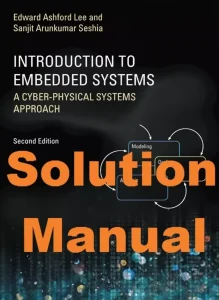
First product is official resources for 2nd edition which includes Solution Manual and Figures. The Solution Manual is a PDF file with 181 pages and covers all chapters 1 to 17 + appendixes A and B. Total file size: 34.3MB. We recommend checking the sample to confirm content quality.
Download Sample for Solutions for Introduction to Embedded Systems 2nd edition
Skip to PDF content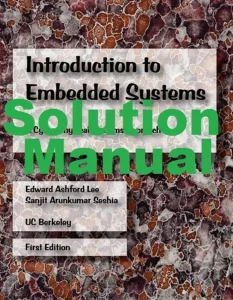
Second product is official solution manual for 1st edition. It is a PDF file with 122 pages which covers chapters 1 to 15 + appendixes A/B. The complete product size is 34.5MB; make sure to review the sample provided.
Download Sample for Solutions for Introduction to Embedded Systems 1st edition
Skip to PDF contentTable of Contents for Solution Manual 2nd edition
- Chapter 1 – Introduction,
- Par I : Modeling Dynamic Behaviors
- Chapter 2 – Continuous Dynamics
- Chapter 3 – Discrete Dynamics
- Chapter 4 – Hybrid Systems
- Chapter 5 – Composition of State Machines
- Chapter 6 – Concurrent Models of Computation
- Part II : Design of Embedded Systems
- Chapter 7 – Sensors and Actuators
- Chapter 8 – Embedded Processors
- Chapter 9 – Memory Architectures
- Chapter 10 – Input and Output
- Chapter 11 – Multitasking
- Chapter 12 – Scheduling
- Part III : Analysis and Verification
- Chapter 13 – Invariants and Temporal Logic
- Chapter 14 – Equivalence and Refinement
- Chapter 15 – Reachability Analysis and Model Checking
- Chapter 16 – Quantitative Analysis
- Chapter 17 – Security and Privacy
- Part IV : Appendices
- Appendix A – Sets and Functions
- Appendix B – Complexity and Computability
About the main textbook:
Introduction to Embedded Systems, A Cyber-Physical Systems Approach (2nd Edition) by Edward Ashford Lee and Sanjit Arunkumarr Seshia is a widely acclaimed textbook that transforms the way engineering students and professionals think about embedded computing. Unlike traditional books that focus only on microcontrollers or electronics, this work presents embedded systems as cyber-physical systems (CPS) — integrated networks where computation interacts tightly with physical processes. It shows how software and hardware coexist to sense, react, and control the real world, from automobiles and robots to smartphones and industrial automation.
The book begins by building a conceptual foundation. Readers are introduced to the basic principles of time, concurrency, and determinism — crucial aspects when designing systems that must respond predictably in real time. The authors then explore modeling techniques that connect digital algorithms with continuous dynamics in the physical environment. This mathematical precision allows engineers to describe, test, and verify system behavior before implementation, reducing both design errors and safety risks.
One of the book’s strongest contributions is its unified approach to computation and control theory. It brings together software engineering, real-time operating principles, and system design practices under a single framework. The authors emphasize designing for reactiveness and timing correctness, showing how embedded programs must adapt to feedback from physical sensors and actuators. Examples throughout the text are carefully selected from modern technologies — including autonomous vehicles, drones, medical monitoring devices, and Internet of Things (IoT) applications — making the content relevant and practical.
The Solutions for Introduction to Embedded Systems are essential for learners who want to deepen their understanding through problem-solving. They provide detailed analyses of exercises covering modeling, temporal logic, scheduling, and architecture. These solutions help clarify complex topics such as hybrid system behavior, model-based design, and hardware-software co-design. The Solutions for Introduction to Embedded Systems also reinforce theoretical principles by linking them with programming examples — particularly in Python and embedded C — enabling readers to see how abstract concepts translate into functioning systems.
Further, the book emphasizes verification and validation, which are critical to ensuring reliability in safety‑critical applications. By presenting both formal verification methods and simulation strategies, Lee and Seshia show how to rigorously check system correctness in environments where failure can be catastrophic. This makes the text extremely useful not only for students but also for professionals designing embedded controllers in aerospace, automotive, and industrial domains.
In summary, Introduction to Embedded Systems, A Cyber-Physical Systems Approach (2nd Edition) is more than a programming guide — it is a structured roadmap for engineering systems that interact seamlessly with the physical world. Through its combination of theoretical depth and hands-on applications, it has become a reference point in both academia and industry. The accompanying Solutions for Introduction to Embedded Systems provide a practical bridge from concept to real implementation, making this book a complete learning resource for anyone engaged in modern embedded or cyber-physical system design.
You can find more information about the textbook in this link.
The main textbooks are excluded. These products provide the Solution Manual + other files (not textbooks) as mentioned above. See details above and reach out anytime if you need assistance or more information.