Solution Manual for Engineering Fluid Mechanics – 12th, 11th International and 10th Edition
Authors: Donald F. Elger, Barbara A. LeBret, Clayton T. Crowe, John A. Roberson
Access to the official Solution Manual for Engineering Fluid Mechanics by Elger (10th, 11th ISV and 12th Edition) on this page. Got questions? Don’t hesitate to contact us.
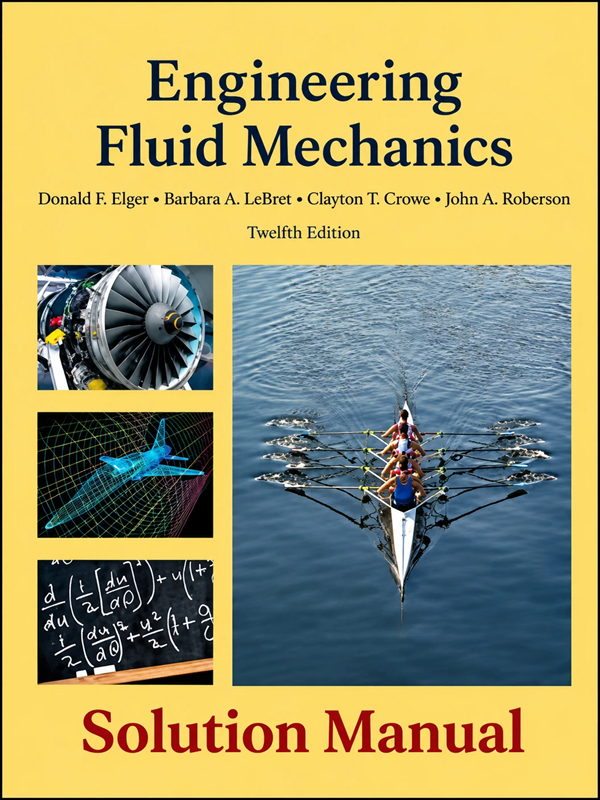
First product is the official Solution Manual for the 12th Edition covers chapters 1 through 16 (excluding chapter 15). Organized into individual PDF files per chapter, the complete package spans a total of 1,385 pages. Additionally, it includes Instructor’s Supplement Problems and Solutions. The total file size is 76.1 MB. We recommend reviewing the sample below before making your purchase.
Download Sample for Solution Manual for Engineering Fluid Mechanics by Elger – 12th Edition
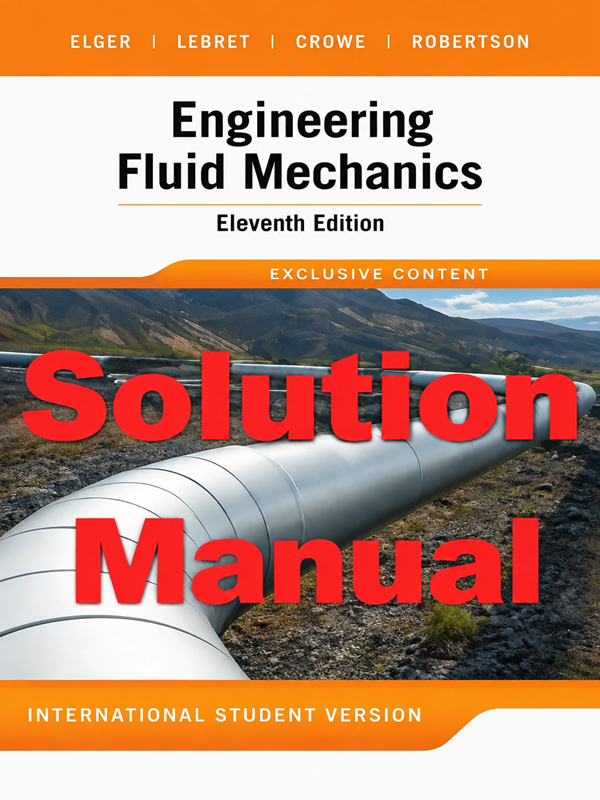
Second Product: This official Solution Manual is designed for the 11th Edition (International Student Version) and is fully complete, covering all chapters of the textbook. This 13.4 MB digital download comes with a preview. Please check the sample before buying.
Download Sample for Solution Manual for Engineering Fluid Mechanics by Elger – 11th Edition
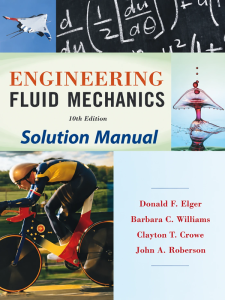
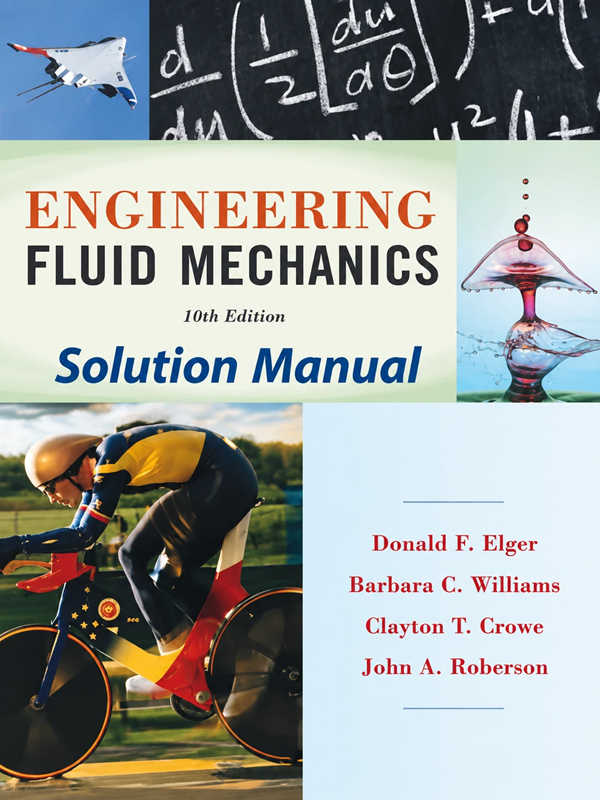
Third product is the complete Solution Manual for the 10th Edition includes all textbook chapters, plus checkpoint problems and appendix problems. Organized into individual PDF files per chapter, the complete package spans a total of 1,673 pages. Total archive size: 11.2 MB. Kindly review the provided sample prior to completing your order.
Download Sample for Solution Manual for Engineering Fluid Mechanics by Elger – 10th Edition
List of covered chapters in Solution Manual for Engineering Fluid Mechanics by Elger (12th Edition)
- Chapter 1 – Introduction
- Chapter 2 – Fluid Properties
- Chapter 3 – Fluid Statics
- Chapter 4 – The Bernoulli Equation and Pressure Variation
- Chapter 5 – The Control Volume Approach and The Continuity Equation
- Chapter 6 – The Momentum Equation
- Chapter 7 – The Energy Equation
- Chapter 8 – Dimensional Analysis and Similitude
- Chapter 9 – Viscous Flow Over a Flat Surface
- Chapter 10 – Flow in Conduits
- Chapter 11 – Drag and Lift
- Chapter 12 – Compressible Flow
- Chapter 13 – Flow Measurements
- Chapter 14 – Turbomachinery
- Chapter 15 – Flow in Open Channels (not covered in the Solution Manual)
- Chapter 16 – Modeling of Fluid Dynamics Problems
About the main textbook:
Engineering Fluid Mechanics (12th Edition), authored by Donald F. Elger, Barbara A. LeBret, Clayton T. Crowe, and John A. Roberson, is one of the most widely respected textbooks across mechanical, civil, chemical, and aerospace engineering curricula worldwide. Published by Wiley, this edition builds upon decades of pedagogical refinement, focusing on helping undergraduate engineering students develop both physical intuition and mathematical problem-solving skills in fluid dynamics.
At its heart, this textbook emphasizes a systematic approach to problem solving, often referred to as the System, State, and Process framework. The authors avoid treating fluid mechanics as merely a collection of isolated formulas. Instead, they structure each topic around fundamental physical principles—conservation of mass, linear momentum, angular momentum, and the first and second laws of thermodynamics. The 12th edition specifically focuses on:
- Physical Visualization: Using high-quality schematics, engineering photographs, and step-by-step illustrations to help learners picture fluid behavior before setting up governing differential or integral equations.
- Structured Problem-Solving Methodology: Teaching students how to identify control volumes, state explicit assumptions (e.g., incompressible, steady, inviscid flow), and systematically execute derivations.
- Application to Modern Engineering Challenges: Connecting theoretical derivations to contemporary engineering practices, including renewable energy systems (wind and hydro turbines), environmental fluid flow, microfluidics, and pipe networks.
Because the textbook covers a rigorous mathematical curriculum, students frequently consult supplementary study resources. Having access to the Solution Manual for Engineering Fluid Mechanics by Elger allows engineering students to verify their analytical steps, validate intermediate assumptions, and build confidence when preparing for midterm and final examinations. The book is arranged logically to take students from elementary statics to complex viscous and compressible flows:
- Fluid Properties and Statics (Chapters 1–3): The initial sections define fundamental fluid properties such as viscosity, surface tension, bulk modulus, and vapor pressure. The text then transitions to fluid statics, exploring hydrostatic pressure distributions, manometry, buoyancy, and forces on submerged surfaces—critical concepts for civil and ocean engineering.
- Flow Concepts and the Bernoulli Equation (Chapters 4–5): Here, students learn Eulerian versus Lagrangian descriptions, streamlines, and flow visualizations. Chapter 5 introduces the Bernoulli equation and the control volume approach, highlighting the limits of inviscid flow assumptions and pitot tube operations.
- Control Volume Analysis and Conservation Laws (Chapters 6–7): These chapters form the core analytical foundation. Students apply the Reynolds Transport Theorem (RTT) to derive conservation of mass, linear momentum, and energy across finite control volumes.
- Differential Analysis and Viscous Flow in Pipes (Chapters 8–10): The text introduces differential fluid elements, continuity, and Navier-Stokes equations, then progresses to internal flows. It provides an in-depth treatment of laminar and turbulent pipe flows, Moody charts, friction factors, and minor losses in commercial piping networks. Working through these extensive calculation sets is made significantly easier when students refer to the Solution Manual for Engineering Fluid Mechanics by Elger to verify complex friction factor interpolations and iterative Reynolds number solutions.
- Dimensional Analysis and Similitude (Chapter 8): The Buckingham Pi theorem and dimensionless parameters (Reynolds, Froude, Mach, and Weber numbers) are thoroughly explored, preparing students for experimental design and model scaling.
- External Flows, Boundary Layers, and Turbomachinery (Chapters 11–14): The book details boundary layer development, laminar-to-turbulent transition, skin friction, and pressure drag on blunt bodies, airfoils, and vehicles. It also addresses pump selection, specific speed, system matching, and turbine dynamics.
- Advanced Topics (Chapters 15–16): Covering open channel flow in hydraulic engineering and one-dimensional compressible flow (isentropic expansion, normal shocks, and nozzle dynamics), ensuring advanced learners possess complete foundational mastery.
Fluid mechanics is widely considered one of the most conceptually demanding courses in undergraduate engineering. The blend of vector calculus, non-linear partial differential equations, and empirical correlations creates significant friction for learners.
For educators designing coursework, quizzes, and homework problem sets, the official Solution Manual for Engineering Fluid Mechanics by Elger serves as an indispensable reference to ensure accuracy across varied problem types and numerical parameters. Similarly, self-directed learners and graduate students preparing for the Fundamentals of Engineering (FE) or Principles and Practice of Engineering (PE) exams benefit immensely from detailed step-by-step solutions. Utilizing the Solution Manual for Engineering Fluid Mechanics by Elger ensures that learners can quickly pinpoint where computational or conceptual errors occurred in multi-step hydraulic calculations.
The 12th Edition of Engineering Fluid Mechanics by Donald F. Elger and co-authors remains an authoritative, accessible, and mathematically balanced cornerstone text. Its structured problem-solving approach, rich illustrations, and exhaustive exercise sets ensure that students develop genuine engineering competence in analyzing complex fluid systems.
You can find more information about the textbook in this link.
Please note: These products include the Solution Manuals + other mentioned files. Please note that the main textbook is not included with this purchase. Reach out to us if you need help.