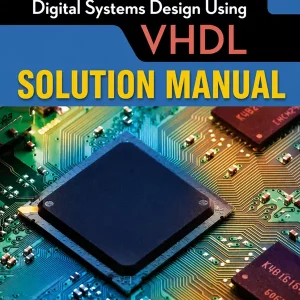
Solution Manual for Digital Systems Design Using VHDL – 3rd Edition
Authors: Charles H. Roth Jr, Lizy Kurian John
Solution Manual for Digital Systems Design Using VHDL by Roth and John directly available for is available for purchase on this page. Need more information? Contact us anytime with your questions.
This product is the official resources for 3rd Edition which includes Instructor Solution Manual, Lecturer’s PowerPoint slides, Lab Manual, Processor FPGA + some other files. Instructor’s Solution Manual covers chapters 1 to 11, there is one PDF file for each of chapters which has 288 pages. The Lecturer’s Slides are availble for chapters 1 to 12 in PPT format. Download size: 49.1 MB. Please examine the sample preview below to ensure it meets your requirements before buying.
Download Sample for Solution Manual for Digital Systems Design Using VHDL by Roth and John
List of Covered Chapters in the Solution Manual for Digital Systems Design Using VHDL by Roth and John
- Chapter 1 – Review of Logic Fundamentals
- Chapter 2 – Introduction to VHDL
- Chapter 3 – Introduction to Programmable Logic Devices
- Chapter 4 – Design Examples
- Chapter 5 – SM Charts and Microprogramming
- Chapter 6 – Designing with Field Programmable Gate Arrays
- Chapter 7 – Floating-Point Arithmetic
- Chapter 8 – Additional Topics in VHDL
- Chapter 9 – Design of RISC Microprocessors
- Chapter 10 – Verification of Digital Systems
- Chapter 11 – Hardware Testing and Design for Testability
About the main textbook:
Digital Systems Design Using VHDL, 3rd Edition by Charles H. Roth, Jr. and Lizy Kurian John is a well-known textbook for students and engineers who want to learn how digital hardware is designed and described using VHDL. It combines the theory of digital logic with practical hardware description methods, making it useful for both academic study and real design work.
The book usually starts with the foundations of digital systems, such as number systems, logic gates, Boolean algebra, combinational circuits, and sequential circuits. From there, it moves into the use of VHDL as a language for modeling, simulating, and designing hardware. This makes it especially valuable because it does not treat VHDL as just a programming language; instead, it shows how VHDL maps to actual hardware behavior.
One of the book’s main strengths is its step-by-step teaching style. It explains topics like multiplexers, decoders, registers, counters, finite state machines, and memory systems in a structured way. Then it shows how to implement these designs in VHDL. This helps readers connect abstract circuit ideas with code that can be synthesized onto FPGA or ASIC platforms.
Another strong feature is its treatment of hierarchical and modular design. Readers learn how large digital systems are built from smaller reusable components. The book also covers simulation and testing, which are critical in hardware design. Writing a VHDL module is only part of the work; verifying correctness through testbenches and simulation is equally important, and the text helps build that mindset.
The 3rd edition is especially appreciated for balancing classical digital design principles with modern HDL-based methodology. It is often used in university courses because it supports both beginners and more advanced learners. Beginners benefit from the clear explanations and examples, while advanced readers can use it as a reference for structured VHDL design practices.
If you are studying this book, you are likely aiming to understand not only how digital circuits work, but also how to describe them formally for implementation. That makes it an important bridge between textbook logic design and industry-relevant hardware engineering.
Some readers search online for extra study resources such as “Solution Manual for Digital Systems Design Using VHDL by Roth and John” to help them check their understanding. In that context, “Solution Manual for Digital Systems Design Using VHDL by Roth and John” is often mentioned by students looking for worked answers and guidance. At the same time, relying only on “Solution Manual for Digital Systems Design Using VHDL by Roth and John” is less effective than working through the design problems yourself. Ideally, “Solution Manual for Digital Systems Design Using VHDL by Roth and John” should be used as a supplement for learning, not as a substitute for practice.
Overall, this book is a solid choice for anyone learning digital logic design with VHDL. It is clear, practical, and academically respected. If your goal is to gain a strong foundation in digital electronics and hardware description, this text is one of the better options available.
You can find more information about the textbook in this link.
Please note that this product does not contain the original textbook. It includes only the Solution Manual + Lecturer’s PowerPoint slides + Lab Manual + Processor FPGA + other files mentioned above. Should you have any inquiries or need assistance, please don’t hesitate to contact our team.