

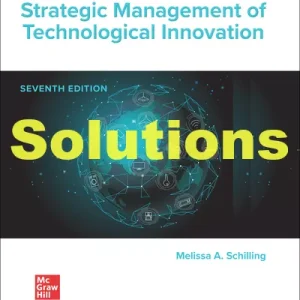

Solution Manual and Test Bank for Strategic Management of Technological Innovation, 7th Edition
Author: Melissa Schilling
Solution Manual and Test Bank for Strategic Management of Technological Innovation by Schilling is sold on this page. You can contact us if you have any questions.

First product is official resources for 7th Edition which includes Instructor’s Manual and Lecturer’s PowerPoint slides. Instructor Manual is a Word file with 187 pages and covers chapters 1 to 13 and includes answers to opening questions, answers to discussion questions and So we can name it Solution Manual. Also, Lecturers PowerPoint slides are available for all chapters. Total size of First product is 10.4 MB. Following sample includes small part of upper resources; so it is better to check it before the purchase.
Download Sample for Solution Manual
Second product is official Test Bank for 7th Edition which is available in Word and PDF format. It has 159 pages and includes 621 questions (True/False and Multiple Choice questions + Essays). Answers are available at the end of the files. Kindly review the sample provided before making your purchase.
About the main textbook:
“Strategic Management of Technological Innovation,” 7th Edition by Melissa Schilling is a comprehensive guide that explores the intersection of technology and strategic management. The book delves into how organizations can effectively manage innovation in a rapidly changing technological landscape. Schilling emphasizes the importance of aligning technological advancements with strategic business goals, making this text essential for students and professionals in fields such as business, engineering, and technology management.
In “Strategic Management of Technological Innovation,” Schilling outlines key concepts and frameworks that help readers understand the processes involved in technological innovation. The book begins by defining innovation and its various types, including incremental and radical innovations. Schilling highlights the significance of understanding the innovation life cycle, from idea generation to commercialization, and discusses the role of research and development (RD) in fostering innovation within organizations.
One of the central themes in “Strategic Management of Technological Innovation” is the idea that successful innovation requires a strategic approach. Schilling emphasizes that organizations must not only be creative but also strategically manage their resources and capabilities to bring innovations to market effectively. She introduces various strategic frameworks, such as the Technology Adoption Life Cycle and the Diffusion of Innovations theory, to illustrate how technologies spread within markets and how firms can position themselves to capitalize on emerging trends.
The book also addresses the role of collaboration and partnerships in innovation. Schilling discusses how firms can leverage external resources, such as alliances with other companies, universities, and research institutions, to enhance their innovation capabilities. This aspect is particularly relevant in today’s interconnected world, where technological advancements often require a collaborative approach to succeed.
Schilling further explores the challenges associated with managing technological innovation, including issues related to intellectual property, competition, and market dynamics. She provides insights into how firms can navigate these challenges by developing robust strategies that account for both internal and external factors influencing innovation.
Throughout “Strategic Management of Technological Innovation,” Schilling incorporates real-world case studies and examples to illustrate her points. These case studies provide practical insights into how leading companies have successfully managed technological innovation and the lessons that can be learned from their experiences. By analyzing these cases, readers gain a deeper understanding of the complexities involved in innovation management and the strategies that can lead to success.
The 7th edition of “Strategic Management of Technological Innovation” has been updated to reflect the latest trends and developments in technology and innovation management. Schilling incorporates contemporary examples from various industries, ensuring that the content remains relevant for today’s readers. This edition also includes new chapters that address emerging topics such as digital transformation, artificial intelligence, and sustainability in innovation.
In summary, “Strategic Management of Technological Innovation,” 7th Edition by Melissa Schilling is an essential resource for anyone interested in understanding how to strategically manage technological innovations in a competitive landscape. The book’s comprehensive approach, combined with its practical insights and real-world examples, makes it a valuable addition to the literature on innovation management. Through this text, readers will gain a solid foundation in the principles and practices necessary for successfully navigating the complexities of technological innovation.
You can find more information about the textbook in this link.
These products do not contain the main textbooks. They include Test Bank + Instructor’s Manual (+ Solutions) + Lecturer’s PowerPoint slides as described upper. You can contact us if you have any questions.


