

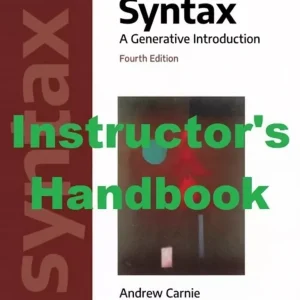

Solution Manual for Syntax: A Generative Introduction – 3rd and 4th Edition
Author: Andrew Carnie
You can find and purchase the Solution Manual for Syntax by Andrew Carnie for 4th and 3rd Editions here. Feel free to contact us if you have any questions.

First product is official resources for 4th edition which includes Instructor’s Handbook and lecturer’s PowerPoint slides. The answers for general and challenge Problems sets exist in instructor’s handbook. Instructor Handbook is a PDF file with 298 pages. The product size is 22.1 MB. Please take a moment to examine the sample provided.
Download Sample for Solution Manual for Syntax by Andrew Carnie 4th edition
Skip to PDF content
Second product is official resources for 3rd edition that includes Problem Sets and Instructor’s Handbook. The Problem Sets is a word file with 117 pages. Instructor’s Handbook is a PDF file with 271 pages. This product is 5.11 MB in size. Make sure to check the sample preview before buying.
Download Sample for Solution Manual for Syntax by Andrew Carnie 3rd edition
Skip to PDF contentTable of Contents for Instructor’s Handbook 4th edition
- Chapter 1 – Generative Grammar
- Chapter 2 – Parts of Speech
- Chapter 3 – Constituency, Trees, and Rules
- Chapter 4 – Structural Relations
- Chapter 5 – Binding Theory
- Chapter 6 – X-bar Theory
- Chapter 7 – Extending X-bar Theory to Functional Categories
- Chapter 8 – Constraining X-bar: Theta Theory
- Chapter 9 – Auxiliaries and Functional Categories
- Chapter 10 – Head-to-Head Movement
- Chapter 11 – DP Movement
- Chapter 12 – Wh-movement and Locality Constraints
- Chapter 13 – A Unified Theory of Movement
- Chapter 14 – Ditransitives
- Chapter 15 – Raising, Control, and Empty Categories
- Chapter 16 – Ellipsis
- Chapter 17 – Advanced Topics in Binding Theory
- Chapter 18 – Polysynthesis, Incorporation, and Non-configurationality
- Chapter 19 – Merge
About the main textbook:
Syntax: A Generative Introduction, 4th Edition by Andrew Carnie is one of the most widely used textbooks for introductory syntax courses across linguistics departments worldwide. Carnie is well known for his accessible and student‑friendly approach to theoretical syntax, and this edition continues to refine the clarity, organization, and pedagogical structure that made the earlier editions so successful.
Designed primarily for undergraduate students—or graduate students encountering formal syntax for the first time—the book introduces the foundational concepts of generative grammar while balancing theoretical rigor with clear explanations and practical examples. It aligns well with the study materials commonly found in syntactic coursework, including resources such as the Solution Manual for Syntax by Andrew Carnie, though the main textbook stands on its own as a complete guide to core syntactic theory.
Carnie begins by grounding students in the fundamental tools used for syntactic analysis: constituency tests, phrase structure rules, lexical categories, and the logic of structural representation. These early chapters lay the foundation for one of the book’s central goals: helping students build syntactic trees and interpret sentence structure based on evidence rather than intuition alone. Carnie’s writing is notably clear and conversational, lowering the barrier to understanding complex concepts without sacrificing theoretical accuracy. As students work through the material, they gradually move from simple structures to more advanced topics such as X‑bar theory, head directionality, and functional projections.
One of the strengths of this 4th edition is its integration of Minimalist concepts alongside traditional generative approaches. The book introduces ideas like feature checking, movement, the Extended Projection Principle, and case theory in a way that feels natural and cumulative. Rather than overwhelming students with formalism, Carnie uses repeated examples, diagrams, and exercises to reinforce each concept. For learners who engage with problem‑solving activities or companion study materials—whether through classroom assignments or tools like the Solution Manual for Syntax by Andrew Carnie—this structured progression makes the theoretical framework more approachable and less abstract.
The exercises at the end of each chapter are especially valuable. They encourage students to practice tree‑drawing, identify syntactic roles, test hypotheses about structure, and diagnose movement operations. The variety of exercise types—from short conceptual questions to full tree analyses—helps develop both analytical and theoretical reasoning skills. The book’s focus on argumentation is particularly important: Carnie emphasizes that syntax is not simply about memorizing rules, but about constructing logical explanations for linguistic phenomena. This approach mirrors the kind of detailed reasoning one finds in teaching tools and supplementary references such as the Solution Manual for Syntax by Andrew Carnie, which reinforce the analytical methods central to the textbook.
Another notable feature of the 4th edition is its incorporation of real linguistic data from a range of languages. Carnie’s commitment to cross‑linguistic examples helps students understand syntax as a universal system with language‑specific variation, rather than a framework tailored only to English. This diversity encourages critical thinking and exposes students to the broader goals of generative grammar: discovering the principles that shape human linguistic knowledge.
In sum, Syntax: A Generative Introduction, 4th Edition offers a comprehensive, student‑centered introduction to generative syntax. Its clear explanations, step‑by‑step structure, and rich set of exercises make it one of the most effective resources for building foundational skills in syntactic theory.
You can find more information about the textbook in this link.
Please note that the main textbook is not included. These products provide the Solutions + other files (not textbooks) as mentioned above. If you have questions, you can always contact us.
